
Why Did Amazon Delete 1984 From Kindles After Customers Bought It?
Amazon removed allegedly unauthorized editions from customers' Kindles to enforce a copyright takedown, exposing the conflict between a promised permanent copy and the platform's continuing control after delivery.
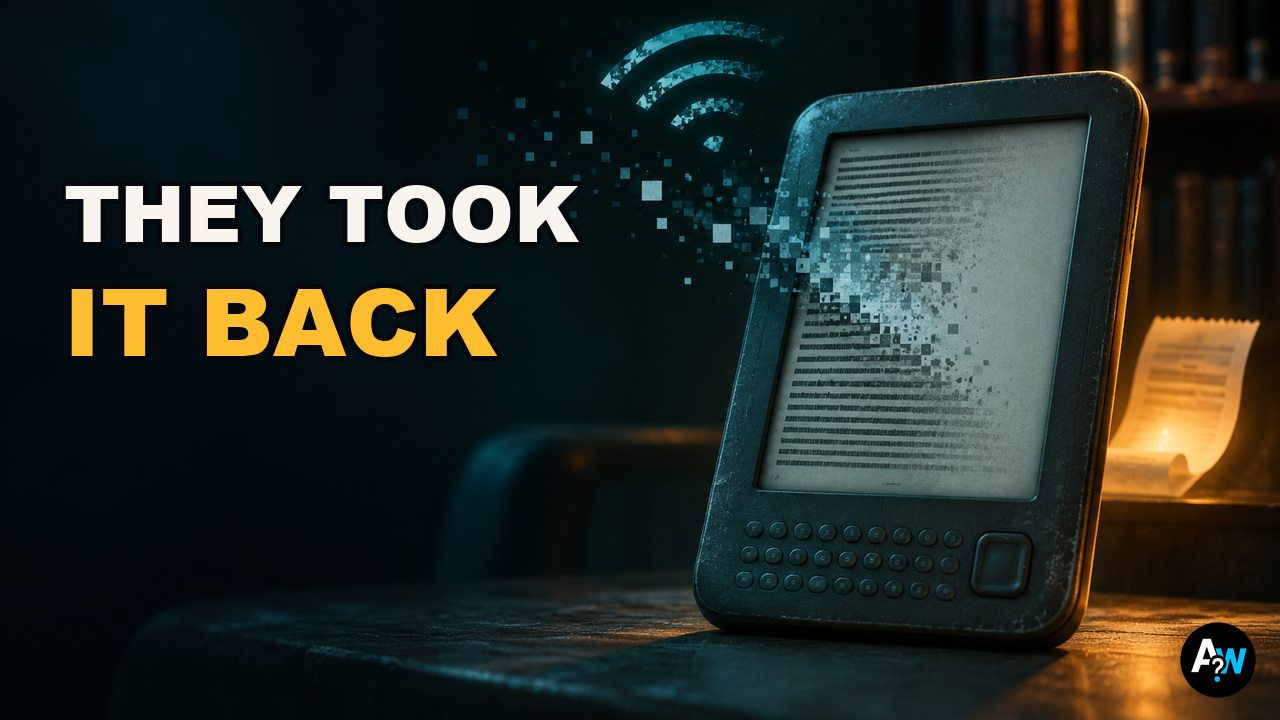
Premieres November 16, 2026 at 8:00 PM CST. The video will play here after its scheduled YouTube release.
Read the evidence, decisions, and consequences behind this investigation.
The question: The Permanent Copy That Vanished
Why Did Amazon Delete Nineteen Eighty-Four From Kindles After Customers Bought It?
Amazon sold customers a Kindle edition of George Orwell's Nineteen Eighty-Four under terms that promised the right to keep a “permanent copy.”
Then Amazon refunded purchasers and remotely removed the book from connected Kindles.
The settlement says the removals happened in fewer than two thousand instances, and one involved a seventeen-year-old student named Justin Gawronski.
According to his later court complaint, Gawronski had paid ninety-nine cents for the novel as summer reading, added annotations, and then powered on his Kindle Two to discover that the text was gone.
His separate note file remained, but the notes no longer linked to the passages they were supposed to explain.
Amazon had not banned Orwell, and this was not political censorship. Amazon said a third party had sold editions without the necessary distribution rights, and it was trying to correct that copyright problem.
But Amazon corrected the seller's mistake by reaching through a wireless device and taking back something its customer believed he had already bought.
And it could hardly have chosen a more unsettling book to make disappear.
A Bookstore Designed to Disappear
Amazon introduced the first Kindle on November nineteenth, two thousand seven, after more than three years of development.
The device cost three hundred ninety-nine dollars, launched with more than ninety thousand books, and could download them wirelessly without a computer.
Jeff Bezos said the design goal was for the Kindle itself to “disappear” so readers could focus on the author's words.
That was the sales pitch: the machine should fade away, leaving only the book.
The Kindle launch also included a self-service route through which authors and publishers could make books available in the store.
By June two thousand nine, Amazon was selling the original Kindle, the Kindle Two, and the larger Kindle D X.
The hardware had changed, but the purchase language made the experience sound reassuringly familiar. For purchased digital content, Amazon's terms granted customers a non-exclusive right to keep a permanent copy and view it an unlimited number of times on the device for personal use.
That wording did not say, “You own this exactly like a paper book.” But “permanent copy” gave customers a very good reason to expect the file would remain after the sale.
The Unauthorized Editions
Then a third party used Amazon's platform to offer certain Kindle editions of Nineteen Eighty-Four, Animal Farm, and a compilation. Amazon said the third party lacked the necessary rights.
In June two thousand nine, Amazon received demands alleging that those editions infringed copyright.
Amazon therefore faced a legitimate problem: its store had completed sales that, according to Amazon, the seller was not authorized to make.
It could stop future sales, remove the listings, and return customers' money. Amazon did all of that—but it also removed the files already delivered to customers' devices.
That last step transformed an ordinary takedown into something that felt like remote repossession.
Authorized editions could still be sold, so this was not an attempt to suppress the ideas in Orwell's books. The mistake was not why Amazon acted; it was how far Amazon believed the correction should reach.
Now translate that remedy into a physical bookstore: the seller enters a customer's home, retrieves the copy, and leaves a refund on the table.
Kindle's wireless connection gave Amazon a digital version of that power.
Two Customers, One Unwanted Refund
Gawronski's complaint alleged that Amazon removed Nineteen Eighty-Four when he powered on his connected Kindle.
He did not allege that the separate annotation file vanished; he alleged that, without the book's text and linked locations, his notes became largely useless.
That distinction matters because “Amazon deleted a student's homework” is catchy, but not quite accurate.
Another buyer, Antoine Bruguier, had paid three dollars and twenty cents for an affected edition. His complaint described an automated refund email and a notice that activating wireless would remove the title from his Kindle.
Neither customer had requested a refund before Amazon initiated the process.
The money was not the main injury they described. Their objection was that Amazon had treated a completed purchase as if the company still controlled the copy after delivery.
That is why the number of removals can mislead. Fewer than two thousand instances was tiny beside Amazon's whole store, but the incident showed every affected customer that payment did not necessarily end the retailer's technical control.
The Apology and the Lawsuit
The backlash arrived quickly, and Amazon said it was changing its systems so it would not remove books from customers' devices in the same circumstances again.
Jeff Bezos then called the company's handling “stupid, thoughtless, and painfully out of line with our principles.”
The apology conceded the remedy had failed, but it did not end the dispute.
On July thirtieth, two thousand nine, Gawronski and Bruguier filed a proposed class action against Amazon.
The complaint alleged violations including breach of contract, conversion, trespass to chattels, Washington consumer law, and the federal Computer Fraud and Abuse Act.
Those were claims, not verdicts. The case never produced a trial finding that Amazon had committed those violations, and Amazon did not admit liability in the settlement.
That legal precision leaves the central tension intact. Amazon had a real rights problem, but its cure collided with the permanent-copy language that helped make Kindle purchases feel safe.
Put the Book Back, or Take Thirty Dollars
On September third, Amazon offered affected customers a new choice.
They could receive the book again at no charge, with their annotations restored, or take thirty dollars by check or Amazon gift card.
This was different from the original automatic refund. It acknowledged that returning the purchase price did not fully repair the loss of the reading experience, the notes' usefulness, or the customer's trust.
The parties signed a settlement on September twenty-fifth, and the court dismissed the case with prejudice on October seventh.
The settlement required Amazon to pay plaintiffs' counsel one hundred fifty thousand dollars in fees, with KamberEdelson's portion committed to charity. That was not a one-hundred-fifty-thousand-dollar damages award to the two customers.
Most importantly, Amazon accepted written limits on remote deletion for covered purchases under the permanent-copy terms.
For covered works on devices purchased and used in the United States, Amazon agreed not to remotely delete or modify the content unless a listed exception applied.
Those exceptions included customer consent, a requested refund or failed payment, a court or regulatory order, or a deletion reasonably needed to protect the customer, device, or network from harm such as malicious code.
The settlement also excluded certain purchases, so it was not a universal promise that Amazon could never delete any digital content under any circumstances.
It was narrower—and more meaningful—than that: for the purchases it covered, technical ability no longer meant unlimited discretion.
What Amazon Actually Revealed
The irony of deleting Nineteen Eighty-Four made the story famous, but the book's politics did not cause the deletion.
The documented sequence was an allegedly unauthorized listing, a copyright complaint, and Amazon's decision to extend the takedown all the way onto customers' devices.
The lasting issue was the gap between the word “buy” and the architecture behind the purchase.
Place the Kindle remedy beside a paper book, and the difference is immediate: the retailer still had a wireless connection to the delivered file. Kindle combined the convenience of instant delivery with continuing platform control over that file.
Amazon treated the incident like a store recall: remove the allegedly unauthorized product and refund the buyer. Customers described it more like a completed sale being reversed inside their homes.
Both sides of that conflict were real. A rightsholder had a reason to demand that allegedly unauthorized editions stop circulating through Amazon's store. Customers had a reason to believe a permanent copy would remain theirs after payment.
Amazon solved the first problem in a way that exposed the second.
The answer: Why Amazon Deleted Nineteen Eighty-Four
So, why did Amazon delete Nineteen Eighty-Four from Kindles after customers bought it?
Because Amazon said a third party had sold unauthorized editions through its store, and Amazon chose to enforce the takedown not only at the storefront, but on copies already delivered to customers.
The company refunded buyers, but that did not erase the contradiction between a promised permanent copy and a retailer that could still make it disappear.
Backlash, Bezos's apology, customer restitution, and the settlement showed that a legitimate copyright remedy could still violate the trust that made a digital purchase feel like ownership.
Amazon deleted the books to fix what it described as unauthorized sales; it reversed course after the fix exposed a more alarming power than the original marketplace mistake.
Stay sharp, Stay curious. And always ask why, guys.
Follow the record.
What did this story make you question?
Comments are reviewed before they appear publicly. Your email is optional and never published.