
Why Did FedEx Spend Hundreds of Millions Delivering Faxes by Hand?
Federal Express built ZapMail to defend its urgent-document business, but courier legs and proprietary equipment left it exposed to direct faxing while demand and rental revenue fell short.
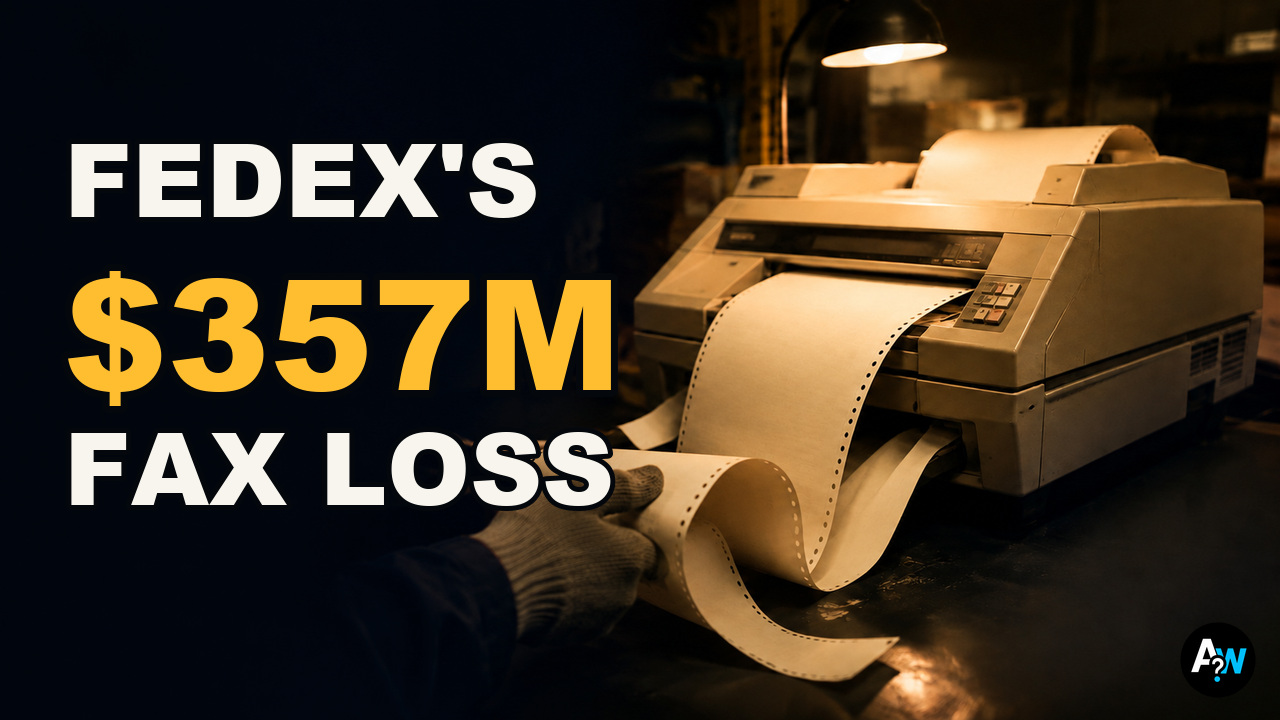
Premieres September 7, 2026 at 8:00 PM CDT. The video will play here after its scheduled YouTube release.
Read the evidence, decisions, and consequences behind this investigation.
The question: A Fax With Two Couriers
Why Did FedEx Spend Hundreds of Millions Delivering Faxes by Hand?
ZapMail officially began in July nineteen eighty-four across most cities where the company then called Federal Express did business.
For an ordinary customer, the document did not travel straight from one fax machine to another.
A Federal Express courier collected the paper, took it to a company location, and fed it into Federal Express equipment.
The document crossed the country electronically, printed at another location, and went back onto the road with a second courier. The advertised door-to-door time was about two hours.
Federal Express had taken a fax and wrapped a delivery network around both ends of it.
The company was not experimenting with pocket change. Period reports put the initial investment at about one hundred million dollars, while plans contemplated roughly one-point-two billion dollars over the following decade.
When ZapMail was phased out, Federal Express recorded a three-hundred-fifty-seven-million-dollar pretax loss for the phase-out and disposal. That was not a three-hundred-fifty-seven-million-dollar construction bill. It was the audited accounting consequence of ending the service.
The strangest part is that the prediction behind ZapMail was right: urgent business documents were moving electronically.
Federal Express had built itself into the part of the journey that direct faxing was about to remove.
Act One — The Network That Made Overnight Possible
Federal Express began operations in nineteen seventy-three with an air-and-ground system designed to move time-sensitive shipments through one coordinated network.
By nineteen eighty-three, the company had passed one billion dollars in annual revenue.
Urgent business documents were an important part of the express market it had built. They could command a premium because waiting another day carried real consequences.
Federal Express had made distance predictable: hand over the envelope today, and the network would put it in another city the next morning.
Then communications technology changed the meaning of fast.
A document that could be scanned and transmitted over a line did not need an aircraft, a sorting hub, or even an overnight wait.
That threatened more than one product. It threatened a reason customers needed Federal Express in the first place.
But it also suggested an opportunity. Most businesses did not yet have a compatible fax machine at every destination. Federal Express already had people and facilities at both ends of the trip.
So instead of waiting for electronic transmission to replace delivery, the company tried to combine them.
Act Two — Building a Private Electronic Highway
ZapMail promised to turn an overnight document into a roughly two-hour delivery without requiring the basic-service customer to own transmitting equipment.
For higher-volume customers, Federal Express placed proprietary ZapMailer units on customer premises, allowing documents to enter its network without the first courier pickup.
The ambition extended beyond a few machines in Federal Express offices. The company discussed a much larger private, satellite-linked communications network that could make ZapMail a major new business.
That design followed the logic that had made Federal Express successful.
The company controlled the air-and-ground system that made overnight delivery reliable, so controlling the electronic system looked like a way to preserve the same service promise.
But an airplane network and a fax network rewarded different kinds of control.
A delivery network became more useful when one operator coordinated aircraft, hubs, routes, and couriers.
A fax network became more useful when customers could buy standard machines and connect directly to one another.
ZapMail sat awkwardly between those models: faster than an overnight envelope, but still dependent on Federal Express locations, specialized equipment, and, in the basic version, two physical courier legs.
It was electronic communication sold with much of the cost structure of delivery still attached.
Act Three — The Customer Has Another Option
Federal Express was asking customers to pay a premium to save hours rather than a full day.
For some deadlines, that difference mattered. But Federal Express's own Overnight Letter was already dependable and familiar.
Period reporting said many customers did not value same-day delivery enough to pay the premium and change their habits. ZapMail competed not only with other electronic systems, but with one of Federal Express's most successful products.
At the same time, standard customer-owned fax machines were becoming a practical alternative. Once both businesses owned compatible machines, a customer could send a document directly and remove the pickup, delivery, and Federal Express network from the transaction.
Technology historians have identified that decentralized, customer-owned network as a major structural problem for ZapMail. Federal Express's own records emphasized narrower business results: volume shortfalls, lower rental income, speed and reliability, operating losses, competition, and the need for capital elsewhere.
The trap was that every standard fax machine a customer bought made electronic documents more normal while making ZapMail less necessary.
Federal Express had predicted the behavior correctly and chosen the wrong place to collect the toll.
Act Four — More Traffic, Bigger Losses
At first glance, ZapMail appeared to be gaining momentum.
Federal Express reported that transmissions rose from five hundred fifty thousand in fiscal nineteen eighty-five to two-point-eight million in fiscal nineteen eighty-six, more than a fivefold increase.
Customer-premise ZapMailers produced two-point-one million of those fiscal nineteen eighty-six transmissions.
But the economics moved in the wrong direction.
The company reported ZapMail operating losses of about one hundred twenty-two million dollars in fiscal nineteen eighty-five and one hundred thirty-two million dollars in fiscal nineteen eighty-six.
The same annual report said revenue fell short because transmission volume and rental income were below expectations. More use did not mean enough use.
Contemporaneous reports put ZapMail at roughly sixteen thousand daily transactions near its peak, compared with more than two hundred fifty thousand Overnight Letters. Those daily transactions and the annual report's fiscal transmissions are different measures, so they should not be combined into one rate.
The company had built a capital-heavy network that needed far more traffic and rental revenue than customers were providing.
The service also had operational problems. In March nineteen eighty-six, Federal Express temporarily suspended additional ZapMailer placements and waived monthly access charges while working to bring speed and reliability up to company standards.
That was the warning before the reversal: the company was giving up revenue and slowing expansion while trying to make the system work better.
Act Five — Smith Stops the Bet
On September twenty-ninth, nineteen eighty-six, Federal Express announced that it would discontinue ZapMail.
Frederick W. Smith told shareholders that the market had proved much harder to stimulate than the company's research indicated.
He said continuing would mean years of further losses and several hundred million dollars of additional investment, while Federal Express also needed capital for aircraft.
This was the real decision point.
Federal Express could keep funding the electronic network because document transmission still looked like the future, or it could admit that this particular network was not going to own that future.
Smith chose the growing delivery company over the service designed to protect it.
Contemporaneous reports said the roughly thirteen hundred ZapMail employees were supposed to remain on the Federal Express payroll and receive other assignments. That was the announced plan, not proof of every employee's eventual outcome.
Pickup-and-delivery service ended later in nineteen eighty-six, while remaining operations and assets were wound down rather than vanishing on announcement day.
By May thirty-first, nineteen eighty-seven, ZapMail had been phased out.
Act Six — The Loss, Properly Counted
The final numbers are easy to flatten into one dramatic figure, but they describe different things.
Period reporting described about one hundred million dollars as the initial investment.
The shutdown announcement was widely reported with a roughly three-hundred-forty-million-dollar pretax write-off.
The audited nineteen eighty-seven annual report later recorded a three-hundred-fifty-seven-million-dollar pretax phase-out and disposal loss, equal to one hundred ninety-five million dollars after tax benefits.
So the clean claim is not that Federal Express spent exactly three hundred fifty-seven million dollars building ZapMail.
It is that ending ZapMail produced a documented three-hundred-fifty-seven-million-dollar pretax accounting loss after a hugely expensive attempt to build a new communications business.
Federal Express reported an overall net loss of sixty-six million dollars for fiscal nineteen eighty-seven, even as revenue from its continuing express-delivery business grew strongly.
ZapMail wounded the company, but it did not destroy it.
Stopping the service protected capital for the network customers were still choosing in enormous numbers.
The answer: The Right Destination, the Wrong Road
So, why did FedEx spend hundreds of millions delivering faxes by hand?
Federal Express saw that electronic transmission threatened its urgent-document business, and it responded with the operating model it trusted most: a private network controlled from end to end.
But ZapMail kept Federal Express couriers, locations, and proprietary equipment in a transaction that standard customer-owned fax machines could perform directly.
Demand and rental revenue fell short. Speed and reliability needed work. And rising transmissions never overcame the service's enormous operating losses.
Federal Express predicted the destination, electronic documents, but mistook a product customers would own for a delivery service it could control.
The company survived because it stopped paying for the wrong road before it consumed the right one.
Stay sharp, Stay curious. And always ask why, guys.
Follow the record.
What did this story make you question?
Comments are reviewed before they appear publicly. Your email is optional and never published.