
Why Did Toyota Teach GM How to Build Better Cars?
Toyota used NUMMI to learn American manufacturing while GM gained direct access to its production system—then discovered that factory tools were easier to copy than trust, authority, and incentives.
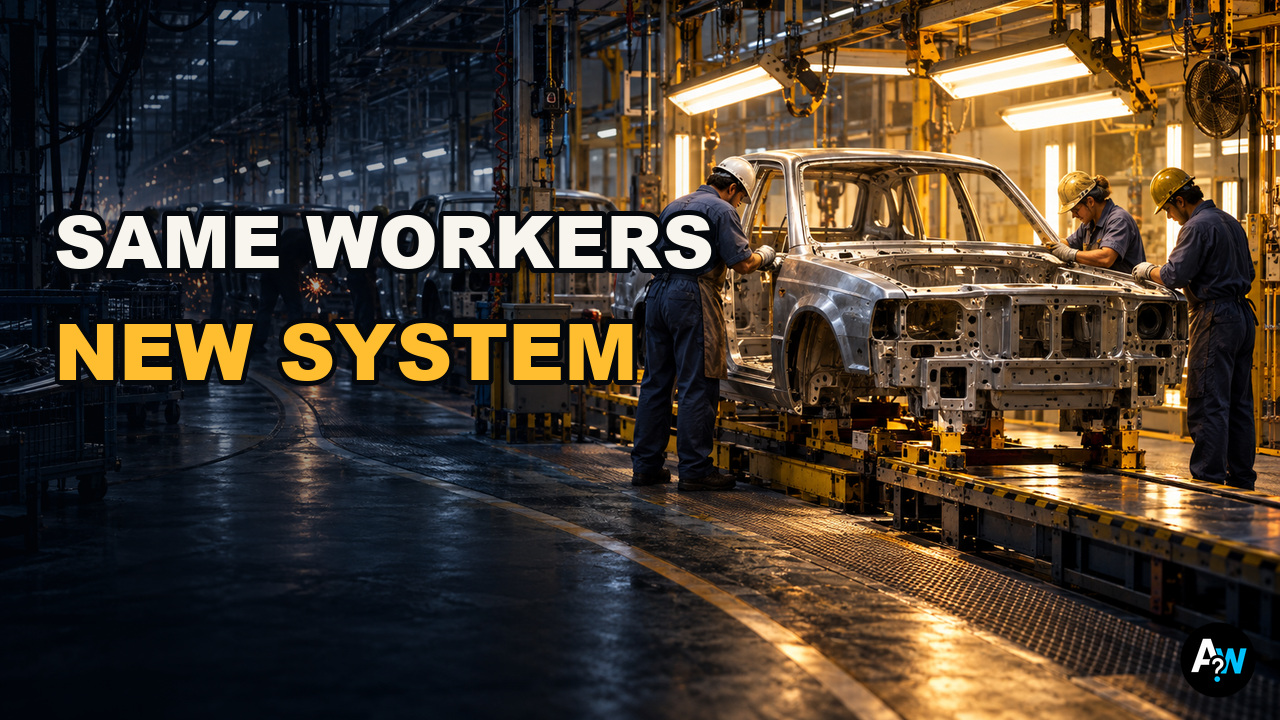
Premieres October 15, 2026 at 8:00 PM CDT. The video will play here after its scheduled YouTube release.
Read the evidence, decisions, and consequences behind this investigation.
The question: The Rival Inside the Factory
Why Did Toyota Teach GM How to Build Better Cars? In nineteen eighty-four, Toyota put its production system inside a factory run by a company it owned equally with General Motors—then helped GM workers learn how to use it. This was not a supplier showing a customer how to tighten one bolt. Toyota was sharing the operating logic behind its reputation for quality with one of its largest rivals. And the test site made the bet even stranger. GM had closed its troubled Fremont, California, assembly plant in nineteen eighty-two. The Smithsonian describes it as GM's least productive plant, while former workers and labor leaders later recalled severe attendance, labor, and quality problems. When it reopened as NUMMI, more than eighty-five percent of the initial workforce came from the old plant, according to the NPR oral history. Mostly the same hourly workers returned, although management and the operating system changed. The result changed dramatically: the Smithsonian says that within five years NUMMI operated as efficiently as Japanese manufacturing facilities, while retrospective participants reported that its cars approached the quality of Corollas built in Japan. Toyota had proved its system could work in America. GM could watch that proof inside a company it half owned—and still struggled for years to reproduce it.
Two Companies Need What the Other Has
At the start of the nineteen eighties, the two companies had opposite problems. GM wanted more compact-car supply and compact-car production knowledge. Toyota was gaining American customers, but import restraints and the threat of local-content rules made United States production increasingly important. Toyota also faced a question no export strategy could answer: could its production system work at scale with American workers, suppliers, contracts, and a union? GM chairman Roger Smith proposed a fifty-fifty joint venture at the closed Fremont plant, with Toyota operating the factory. Toyota leader Eiji Toyoda accepted even though people inside Toyota worried about transferring manufacturing expertise—and a leading small-car design—to a competitor. The bargain was practical on both sides. GM would receive a Corolla-based Chevrolet and direct access to Toyota's methods. Toyota's corporate history says it would gain a relatively low-investment laboratory for learning how to manufacture in the United States. Federal regulators treated the competitive risk seriously. The Federal Trade Commission provisionally accepted the arrangement under a consent agreement in December nineteen eighty-three, then granted final approval in April nineteen eighty-four with limits on the venture. Each company supplied half of NUMMI's announced two-hundred-million-dollar capitalization, and Toyota appointed Tatsuro Toyoda as president. The companies had made a deal on paper. Now Toyota had to reopen the factory GM could not fix.
Rehire the People GM Blamed
Former Fremont workers described the old plant as a place where hostility had become routine. In retrospective interviews, named participants recalled heavy absenteeism, grievances, drinking, sabotage, and a line that was expected to keep moving even when defects appeared. Those are attributed memories, not an audit of every worker. But even UAW western-region leader Bruce Lee called Fremont the worst workforce in the American auto industry. Lee drew a different conclusion from that description: he said the system had produced the behavior. He pushed to bring back the old union leadership, while Toyota and the UAW agreed to rebuild work around teams and a different relationship with management. According to the NPR oral history, more than eighty-five percent of NUMMI's first workforce had worked at old GM Fremont. Toyota was not escaping the workforce GM thought it had. It was running an experiment with mostly the same hourly employees, but new managers and a new operating structure. Before production began, Toyota brought NUMMI leaders to its Takaoka plant in Japan. Toyota's history records two hundred fifty-seven group and team leaders trained there across nine sessions from mid-nineteen eighty-four to early nineteen eighty-five. They did not return with one magic machine. They returned to a factory organized around small teams, broader skills, fewer rigid job classifications, and responsibility for quality where the work happened.
Pull the Cord
The clearest symbol was the andon cord. When a worker spotted a problem, pulling it called a team leader for help. If the problem remained unresolved, the line could stop at a fixed point so the defect could be corrected instead of sent forward. At old Fremont, former workers said stopping production could make the worker look like the problem. At NUMMI, exposing a defect was supposed to trigger support from the team leader. That sounds like a small procedural change. It was really a transfer of authority. The person closest to a bad part no longer had to choose between hiding it and fighting the hierarchy alone. The system also kept less inventory between steps, so mistakes were harder to bury beneath piles of parts. Workers were encouraged to suggest continuous improvements rather than treat the process as somebody else's design. But NUMMI was not a workplace utopia. Workers also described greater intensity, pressure from teammates, fewer seniority privileges, and fear that every efficiency gain might eventually reduce the number of jobs. That tension matters. Cooperation did not remove the conflict between production, control, and job security. It changed what happened when a problem reached the line—and whether the people who found it expected punishment or help.
The Same Workers, a Different Result
The first Chevrolet Nova rolled off the NUMMI line in December nineteen eighty-four. Toyota-badged Corolla FX production followed in September nineteen eighty-six. The turnaround came quickly enough to break the simplest explanation for old Fremont. The Smithsonian says NUMMI was operating as efficiently as Japanese manufacturing facilities within five years. Retrospective participants and researchers also reported sharp falls in defects, grievances, and absenteeism, and defect levels comparable with Corollas made in Japan. Most of the hourly workforce had not been replaced. What changed included management, training, feedback, authority, incentives, the product and process design, and the expectation that leaders would help solve a visible problem. NUMMI did not prove that every worker loved the new system, or that one factory could settle every argument about labor and management. It proved something narrower and more damaging to GM's old assumptions: a workforce that had produced terrible results in one system could produce excellent results in another. Now GM had the demonstration it wanted. The harder question was whether it could carry the lesson beyond Fremont.
GM Tours the Answer
The NPR oral history reports that GM assigned sixteen rising managers to NUMMI. Two Wall Street Journal reporters later dubbed them the NUMMI commandos. Other GM managers toured the plant, studied the floor, and sometimes worked on the line. But a factory is easier to photograph than a relationship. Participant reporting and academic analysis describe managers elsewhere who were rewarded for keeping the line moving and hitting volume targets, even if defects were pushed downstream. Union locals defended seniority, classifications, and staffing rules that workers saw as protection against management. Divisions and suppliers guarded their own practices, and some executives doubted Toyota's quality advantage or treated NUMMI as an isolated exception. Toyota's visible tools could be copied: team boards, floor layouts, inventory rules, even a cord to stop the line. The harder part was convincing everyone that exposing a problem would bring help instead of blame. GM did learn. It developed and spread Toyota-derived production systems, and later plants narrowed parts of the quality and productivity gap. The failure was not zero adoption. It was slow, uneven adoption without the urgency or authority needed to reproduce NUMMI quickly across a vast company. The lesson had crossed the factory gate. It had not yet crossed every incentive that made GM behave like GM.
The Partnership Ends
NUMMI operated for twenty-five years and built about seven-point-seven-four million vehicles for Toyota and GM. Then the partnership lost one of its partners. During GM's twenty-oh-nine bankruptcy reorganization, GM ended Pontiac Vibe production and withdrew from the venture. Toyota said it reviewed its options and concluded that operating without GM was not economically viable. NUMMI ended vehicle production on April first, twenty ten. That ending does not turn NUMMI into a failed experiment. The factory had already given Toyota its first full-scale lesson in building vehicles in the United States, while GM had received compact cars and years of direct access to the system. Nor does NUMMI prove that faster imitation would have prevented GM's bankruptcy. GM's crisis had many causes, and that counterfactual cannot be demonstrated. What the closure does show is that a successful local partnership could not erase the different pressures facing two enormous companies. And then the same factory changed identities one more time.
The answer: Toyota Was Learning Too
Tesla acquired the former NUMMI land and manufacturing facility in twenty ten for forty-two million dollars in cash. Its filings recorded permits, environmental obligations, and a separate equipment purchase apart from that figure. The site became Tesla's Fremont production base. So, why did Toyota teach GM how to build better cars? Because Toyota was not giving away knowledge for nothing. According to Toyota's corporate history, it traded access to its production system for something it did not yet have: a relatively low-investment way to learn American manufacturing with American suppliers, managers, contracts, and a UAW workforce during intense trade pressure. GM received the car, the factory, and the lesson. But NUMMI revealed why Toyota's advantage was difficult to copy: the system was not just equipment or instructions. It was a network of authority, trust, incentives, training, supplier support, and habits that had to change together. Toyota taught because teaching was the price of learning America. GM struggled because seeing a system is much easier than becoming one. Stay sharp, Stay curious. And always ask why, guys.
Follow the record.
What did this story make you question?
Comments are reviewed before they appear publicly. Your email is optional and never published.