
Why Costco Refuses to Raise the Price of Its $1.50 Hot Dog
Costco has held one famous price since 1985 by treating a food-court snack as a promise—and engineering the supply chain around it.
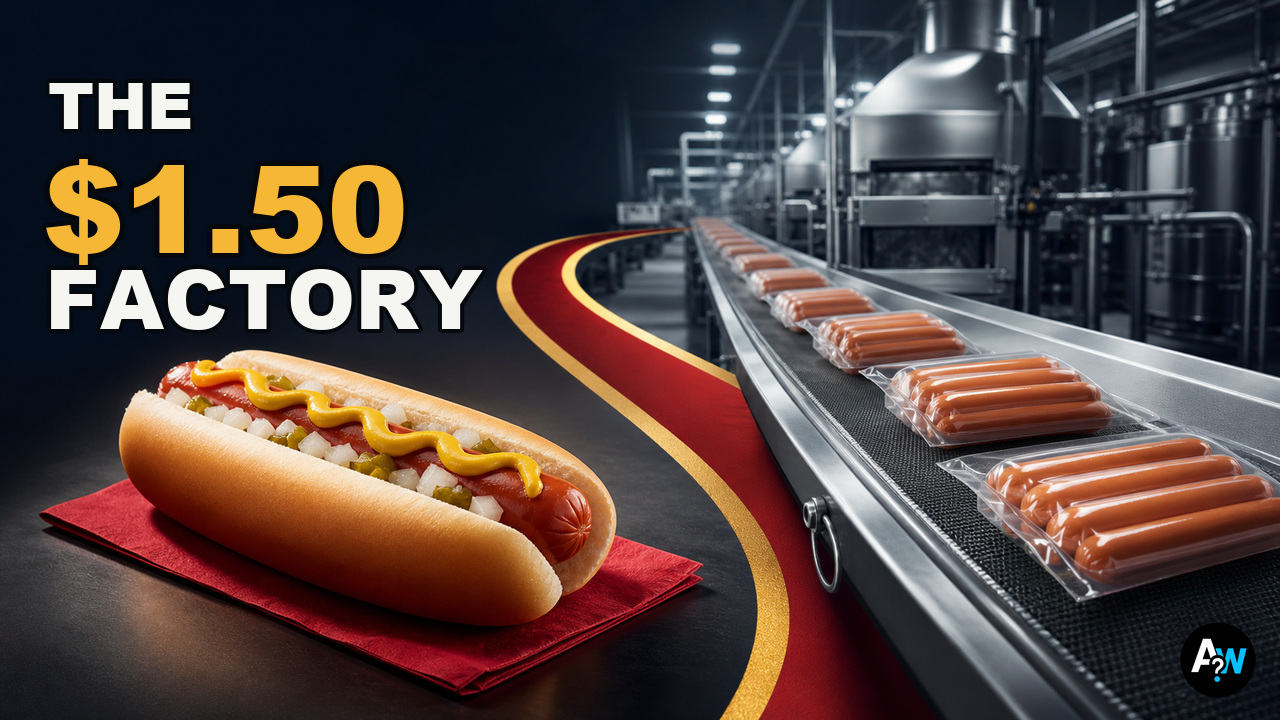
Premieres July 20, 2026 at 8:00 PM CDT. The video will play here after its scheduled YouTube release.
Read the evidence, decisions, and consequences behind this investigation.
The question
Why does Costco refuse to raise the price of its $1.50 hot dog?
2013. Craig Jelinek has been CEO of Costco for less than a year, and he's staring down a number he doesn't like: food costs are rising, labor's rising, and one item on the menu hasn't moved a cent in almost thirty years. So he does what any new CEO would do. He walks over to the man who built this company, the man who technically doesn't run it anymore but everyone still asks first — founder Jim Sinegal — and he floats a small, reasonable idea: raise the hot dog and soda combo by a quarter. A dollar fifty to a dollar seventy-five.
"If you raise the effing hot dog price, I will kill you. Figure it out."
That's not really a joke about lunch. For forty years — through recessions, through beef shortages, through a rival company built specifically to undercut it — that number has never moved. Not once. This is the story of how, and why a founder would rather threaten murder than let it change.
THE BET
In 1983, Jim Sinegal opens the first Costco on a pitch that sounds almost backwards for retail: charge the customer an annual fee just to be allowed in the door, then sell everything else at prices so thin the company barely makes anything on the product itself. The bet was that the fee would feel invisible if the deals inside felt impossible to walk away from.
Two years later, almost as an afterthought, Costco adds a food court — a cheap, fast way to keep members in the store instead of leaving to eat. The hot dog and soda combo goes on the board at $1.50.
Nobody expected the food court to be a profit center. That was never the job. Its job was to be proof — a small, cheap, repeatable reminder that the deal here was real. Which is exactly why, twenty-eight years later, Sinegal was willing to threaten murder over a 25-cent increase. It was never about the quarter. It was about what the quarter would mean.
"FIGURE IT OUT"
So picture it again, now that you know what's actually at stake. Jelinek isn't wrong that costs are rising — he has a real balance sheet to answer to. But Sinegal's answer wasn't really about the balance sheet. It was a test: prove the company can still deliver on the promise, without breaking the one price everyone can recite from memory.
"Figure it out" wasn't a dismissal. It was an assignment. And what Jelinek and his team built over the next several years is the actual answer to our question — because holding a price still while your own costs rise isn't stubbornness. It's engineering, done in three separate moves.
THE FIRST WALL: THE SUPPLIER
The first wall Costco hit came earlier than 2013, actually — around 2008 and 2009. At the time, Costco's food courts ran on kosher beef franks bought from an outside supplier. And that supplier hit a real limit: it couldn't keep guaranteeing the volume of beef Costco needed, at a price Costco could still live with.
This is the point where almost any other retailer makes the easy call: eat the cost, or quietly raise the price a little and hope nobody notices. Costco did neither. It made the harder, more expensive bet — it decided to stop depending on a supplier at all. It repurposed a meat-processing plant in Tracy, California, and by 2011 was manufacturing its own Kirkland Signature hot dogs in-house, at a scale most food-court operators would never justify.
That single decision erased an entire layer of markup permanently. Costco wasn't paying anyone else's profit on top of the meat anymore — just its own production cost, at a volume of roughly 150 million combos sold every year.
One wall down. The next one was hiding in the cup, not the bun.
THE SECOND WALL, AND THE REAL MACHINE
In 2013 — the same year as the confrontation with Sinegal — Costco made its second move: it dropped Coca-Cola from its food courts in favor of Pepsi, purely because Pepsi offered a cheaper wholesale deal. Costco said so, plainly, at the time: the switch existed to protect the $1.50 price.
But here's the part that actually explains everything, and it has almost nothing to do with hot dogs. Costco caps its markup on nearly everything it sells at around 14 to 15 percent — compare that to a normal retailer, which marks products up 25 to 50 percent just to function. Costco can survive on a markup that thin because it isn't really in the business of selling hot dogs, or paper towels, or rotisserie chickens. It's in the business of selling memberships. In a typical year, membership fees alone account for close to — sometimes more than — the company's entire operating income.
Which means the hot dog was never a menu item competing with other menu items. It's a receipt — proof, every single time you buy one, that the membership you already paid for was worth it. That's why Sinegal would rather threaten his own CEO than let it move. A quarter isn't a quarter. It's a crack in the one promise the whole company runs on.
THE RIVAL
And that promise got tested directly. In November 2022, Sam's Club — Walmart's answer to Costco — did something no one had done in decades: it went after the hot dog combo on purpose, cutting its own price to $1.38, twelve cents below Costco, as a deliberate shot across the bow.
It worked, at least a little — Sam's Club's leadership later said the cheaper combo actually boosted overall profits by pulling more members through the door, even on a thinner margin.
Costco's response? Nothing. No price match, no press release, no counter-move. The combo stayed at $1.50. Because if the hot dog is a receipt for trust, you don't win that fight by getting cheaper — you win it by being the one company that doesn't flinch, no matter who's swinging at you.
THE SAME BET, A LOT BIGGER, AND ITS LIMIT
Here's the part that proves this was never a one-off trick — it's a repeatable playbook, and Costco has run it again since, at a much larger scale, on its other famous loss leader: the $4.99 rotisserie chicken.
By the mid-2010s, rising chicken prices meant Costco's own CFO admitted the company was absorbing $30 to 40 million a year in lost margin just to hold that price, while competitors charged $5.99 or more.
So Costco did what it already knew worked: it stopped depending on outside suppliers and built its own. In 2019, its subsidiary Lincoln Premium Poultry opened a $450 million complex in Fremont, Nebraska — hatching, raising, slaughtering, and processing its own chickens, the same fix as the Tracy plant, just two orders of magnitude bigger. That single facility now processes over 100 million chickens a year, supplying roughly 40 percent of Costco's total rotisserie chicken volume.
But this is where the story stops being a highlight reel and gets honest. In December 2025, Costco confirmed it would not move forward with a planned second phase of that Nebraska complex — citing construction costs that have roughly doubled in the eight years since the first phase was planned.
Forty years of refusing to move a price doesn't mean there's no ceiling. It means Costco has, so far, always found one more lever to pull before hitting it. And in a strange bit of symmetry, even the hot dog's own supply chain flipped again recently: after twelve years on Pepsi, Costco quietly switched its food courts back to Coca-Cola in 2025.
The soda changed. The supplier changed. The rival changed. The one number that was never allowed to change — didn't.
The answer
So go back to Jelinek, standing in front of Sinegal in 2013, being told to figure it out. He did — not with one clever trick, but by treating a 25-cent menu item like critical infrastructure: build the factory, switch the supplier, absorb the margin, ignore the rival. All of it, to protect a number that, on paper, costs the company money every single time someone buys it.
Because the day that number moves, it isn't a hot dog price that breaks. It's the one promise the entire membership is built on.
That's a lot of engineering behind a food court snack. But forty years in, it might be the cheapest marketing Costco has ever bought.
Follow the record.
What did this story make you question?
Comments are reviewed before they appear publicly. Your email is optional and never published.