
Why Did Selling Too Many Pickles Nearly Destroy Vlasic?
A gallon jar became a runaway bestseller while quietly crushing Vlasic’s margins, pricing power, and premium identity.
Premieres July 23, 2026 at 8:00 PM CDT. The video will play here after its scheduled YouTube release.
Read the evidence, decisions, and consequences behind this investigation.
The question
Audio: 02voiceover/vo01coldopen.wav · 0:00–0:49.6 (49.6s)
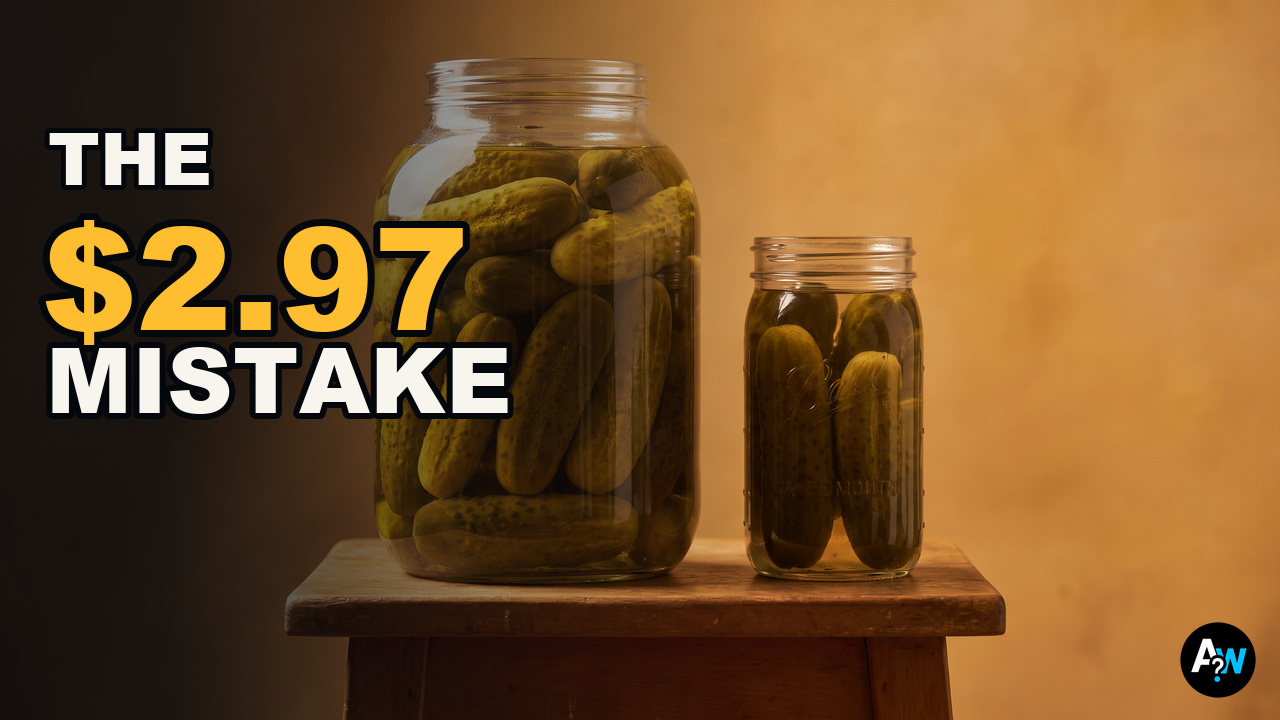
Why did selling too many pickles nearly destroy Vlasic? Sometime in the late 1990s, if you walked into almost any Walmart in America, you'd find a jar of Vlasic pickles the size of a small aquarium. A full gallon. Enough pickles for a family to work through for the better part of a year. And the price on it was almost a joke: two dollars and ninety-seven cents. It sold. Incredibly well. At its peak, Walmart was moving something like eighty of these gallon jars, per store, every week, across roughly three thousand stores. That's about a quarter of a million gallons of pickles a week, flowing out of one retailer. By every normal measure of retail, this was a triumph. A best-seller. A hit. It was also quietly gutting the company that made it.
The Premium Brand
Audio: 02voiceover/vo03act1premiumbrand.wav · 1:16.2–2:13.4 (57.2s)
To understand why the gallon jar was dangerous, you have to know what Vlasic was before it. For decades, Vlasic was the name in pickles, the premium one, the brand with the stork mascot, the jar you reached for and paid a little extra for without really thinking about it. That little extra was the entire business. Vlasic sold pickles in normal, sensible sizes, quarts and spears, at a price that carried a healthy margin. That margin is the thing to keep your eye on. A brand like Vlasic isn't really selling cucumbers in brine. It's selling the idea that Vlasic is worth a bit more than the store brand next to it. Every quart sold at full price reinforced that idea. The premium was the product. And in the late 1990s, Vlasic had a new, enormous, irresistible customer standing at its door, the biggest retailer in the country, offering access to millions of shoppers at once. When Walmart came calling with an idea, Vlasic listened.
The Statement Item
Audio: 02voiceover/vo04act2statementitem.wav · 2:13.4–3:36.0 (82.7s)
The idea came from a Walmart buyer, and it was strange on its face: sell a gallon of Vlasic pickles. Not a quart. A gallon, far more than any normal household could ever reasonably eat before losing interest. And price it at two ninety-seven. Here's the thing, Walmart didn't want the gallon jar because customers were begging for a gallon of pickles. It wanted the jar as a statement. A signpost. Walmart's whole brand was built on the promise that it was the cheapest place in America, and nothing screams we are absurdly cheap quite like a bathtub of pickles for under three dollars. The pickles were almost beside the point. They were a billboard for Walmart's prices. Inside Vlasic, the man who championed the deal ran the Walmart account, a salesman named Pat Hunn. And on paper, saying yes looked like a win. Enormous volume. A flagship placement in every Walmart in the country. The kind of number that makes a sales team look like heroes. But look at the math underneath it. On that two ninety-seven gallon, Vlasic was making, by the account of its own former executives, a profit of about a penny. Maybe two. If that. A penny. On the best-selling pickle item in America.
The Hit That Ate Its Own Brand
Audio: 02voiceover/vo05act3ateownbrand.wav · 3:36.0–4:46.5 (70.5s)
Now, a penny of profit on enormous volume can still be a business, that's basically Walmart's entire model. But for Vlasic, the gallon jar wasn't just thin. It was cannibalizing the profitable business right next to it. Think about it from the shopper's side. You're standing in the aisle. Over here is a quart of Vlasic at full price, carrying that healthy margin. And over there is a gallon of the same brand for two ninety-seven. Why would you ever pay the premium again? The gallon jar was quietly retraining Vlasic's own customers. It was teaching the entire country that Vlasic, the premium name, the brand whose whole value was that it was worth a little more, was actually a thing you bought by the bucket for the price of a soda. The best-seller was dissolving the exact idea the company had spent decades and untold marketing dollars building. And it showed up in the numbers where it mattered most: Vlasic's profits on pickles fell by twenty-five percent or more. Millions of dollars. Not because the pickles were selling badly, but because they were selling spectacularly, at a price that made the whole brand worth less. This is the trap, and it's worth saying plainly: Vlasic was being wounded by its own success. Every one of those quarter-million gallons a week was both a sale and a small cut.
The Turning Point
Audio: 02voiceover/vo06act4turningpoint.wav · 4:46.5–6:02.4 (75.9s)
At some point, Vlasic did the obvious, sane thing. It went to Walmart and asked to raise the price, even a little, even just to make the gallon jar stop bleeding the brand. And this is the moment the whole story turns on. Because Vlasic discovered that it no longer controlled the price of its own product. Walmart did. As Vlasic's former vice president of grocery marketing, Steve Young, later recalled it, Walmart's answer was blunt: if you raise this price, we'll stop buying everything else of yours, too. Not just the pickles, the whole Vlasic line, pulled from the biggest retailer in America. Sit with what that means. Vlasic couldn't afford to raise the price, and it couldn't afford to walk away. It had made itself so dependent on one customer that the customer now set the terms, including the price of the product with Vlasic's own name on the jar. Eventually Walmart itself relented, but not as a rescue. By the account in that same reporting, the reasoning from Walmart's side was almost casual: we've done to pickles what we did to orange juice, we've already killed the category, we've made our point, we can back off now. The gallon shrank to just over a half-gallon, priced at two seventy-nine. The damage to the brand's pricing power was already done.
The Honest Turn
Audio: 02voiceover/vo07act5honestturn.wav · 6:02.4–7:21.5 (79.1s)
And here's where I have to be straight with you, because the tidy version of this story, a gallon of pickles bankrupted Vlasic, isn't quite true, and the real version is more interesting. In January 2001, Vlasic Foods International did file for bankruptcy. But the thing that actually pushed it over the edge wasn't the pickle jar. It was debt. Just a few years earlier, in 1998, Vlasic had been spun off from Campbell Soup as its own company, and it walked out the door already buried, having borrowed on the order of five hundred and sixty million dollars to pay Campbell as part of that split. Add declining sales and questions about inflated pre-spinoff earnings, and Vlasic was fragile long before the pickle math got bad. In the end, its pickle and barbecue-sauce businesses were sold off to Heinz for around a hundred and ninety-five million dollars. So the gallon jar didn't kill Vlasic. The debt did. But the gallon jar is the clearest window we have into how a company like Vlasic gets weak enough to be killed at all, because it shows, in the dumbest possible object, exactly what happens when you hand one customer that much control. A company that could be told the price of its own pickles was a company with no room left to absorb a shock.
The answer
Audio: 02voiceover/vo08closer.wav · 7:21.5–8:02.9 (41.4s)
So, why did selling too many pickles nearly destroy Vlasic? Because selling more and winning are not the same thing, and Vlasic learned the difference the hard way. Its best-selling product earned it almost nothing, taught its customers the brand was cheap, cut its margins by a quarter, and worst of all, proved that it had given a single retailer the power to set its prices and pull its whole line on a whim. The gallon jar was a triumph on every chart a sales team looks at. It was a slow bleed on every one that actually mattered. The stork sold a gallon of pickles for two dollars and ninety-seven cents. It might be the most expensive cheap thing a brand ever sold.
Follow the record.
What did this story make you question?
Comments are reviewed before they appear publicly. Your email is optional and never published.