
Why Did Blue Bell Hide a Listeria Outbreak Instead of Issuing a Recall?
A century-old trust story collided with a contamination warning—and leadership chose a quiet product pull before a public recall.
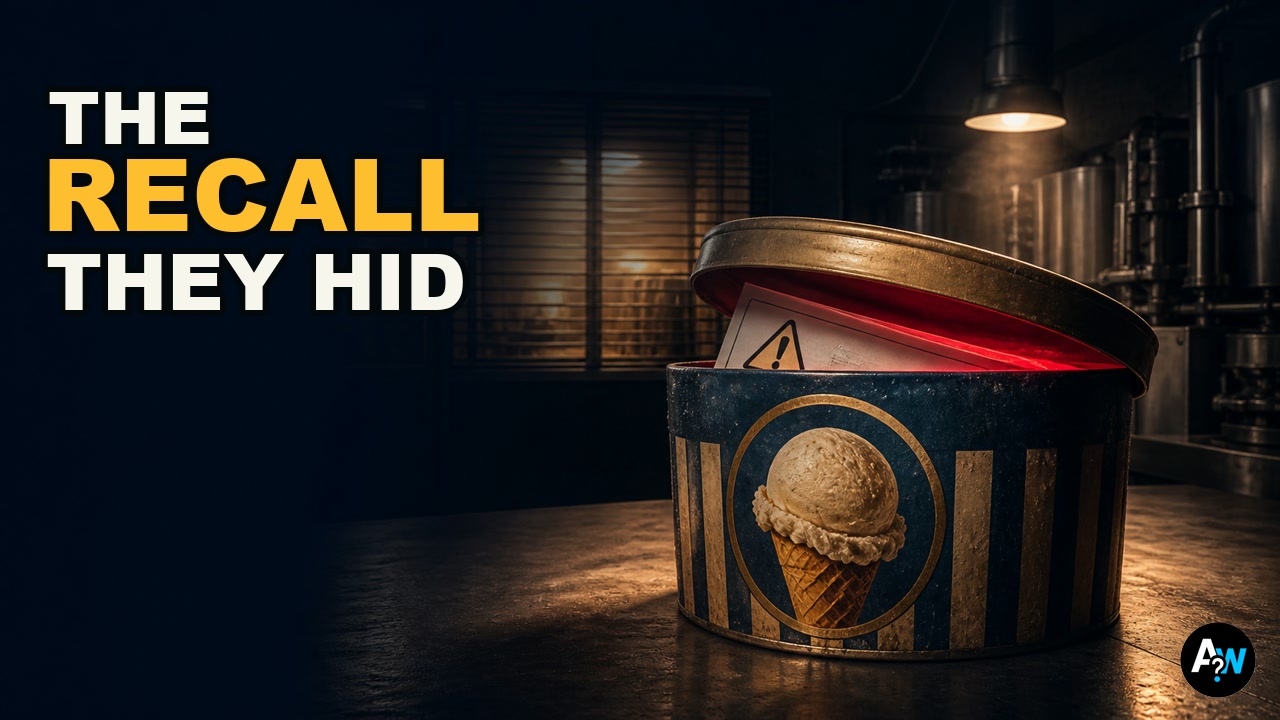
Premieres August 6, 2026 at 8:00 PM CDT. The video will play here after its scheduled YouTube release.
Read the evidence, decisions, and consequences behind this investigation.
The question
Why did Blue Bell hide a listeria outbreak instead of issuing a recall?
For one hundred and eight years, Blue Bell never recalled a single product. Not once. It built its whole identity on being the little creamery in Brenham, Texas -- a small-town, family-run dairy that made ice cream the honest way, one gallon at a time.
Then, in February twenty fifteen, government health inspectors told the company its ice cream had tested positive for a bacterium that can kill. And the people running Blue Bell had a choice: tell the country, or protect the brand.
They chose the brand. People kept eating the ice cream. And three of them didn't survive it.
A Century of Trust
Blue Bell started in nineteen oh seven as a small dairy cooperative for local farmers in Washington County, Texas -- the Brenham Creamery Company. It started making ice cream in nineteen eleven, and in nineteen nineteen, a farmer named E. F. Kruse took over management. His family would run the company for the next hundred years.
By the twenty tens, Blue Bell wasn't a small regional operation anymore -- it was the third-best-selling ice cream brand in the entire United States, turning out roughly one hundred thousand gallons a day. But it never let go of the folksy identity that got it there -- the little creamery in Brenham, the brand that ate all it could and sold the rest.
That image mattered because it wasn't just marketing -- it was the entire business. Blue Bell didn't compete on being the cheapest ice cream in the freezer aisle. It competed on being the one you trusted, made by people who felt like your neighbors. A hundred and eight years without a single recall was proof the trust was earned.
Which is exactly what made the decision in February twenty fifteen so damaging -- not because it was unusual for a company to protect itself, but because for Blue Bell, protecting the image was the entire strategy already. There was no need to choose between the two. And leadership chose wrong anyway.
The Decision
In February twenty fifteen, South Carolina health officials -- testing ice cream samples pulled from a distribution center, not inspecting the plant itself -- found that two products made at Blue Bell's flagship Brenham, Texas plant had tested positive for Listeria monocytogenes -- a bacterium that's especially dangerous to the elderly, pregnant women, and anyone with a weakened immune system.
This was the moment. A company with a hundred and eight years of trust built up in the bank could have spent some of it here -- recalled the product, told customers exactly what was found and where, and let the public decide what to do next.
Instead, according to the federal charges later filed, CEO Paul Kruse directed the two implicated products to be quietly pulled from store shelves. No public recall. No public statement naming listeria at all. Employees who fielded questions from curious customers were told to say only that there had been an unspecified issue with a manufacturing machine.
The ice cream didn't say listeria on the label. The ice cream that was never pulled at all -- the products investigators hadn't yet flagged -- kept shipping, kept getting scooped into bowls, while the company that had never once needed a recall was already quietly managing one, off the record.
The Outbreak
A month later, in Kansas, health officials traced five cases of listeriosis back to a single hospital -- one that had been serving Blue Bell ice cream directly to its patients. Three of those patients died.
We don't know their names. What we do know is that they were already in a hospital bed, already vulnerable, and the thing that reached them was a product from a company that had chosen silence over a warning five weeks earlier.
That's what forced Blue Bell's hand. On March thirteenth, twenty fifteen, the company issued its first public recall -- one plant, one product line. Ten days later, a second Blue Bell plant, this one in Broken Arrow, Oklahoma, turned up contaminated too, and the recall widened again.
Within weeks, it stopped being a partial recall at all. Blue Bell pulled every product it made, from every plant, in every market the company served -- the first total recall in its history.
And when investigators went back and tested retroactively, they found matching strains of listeria in the Brenham plant going back to at least twenty ten -- five years of contamination sitting in a plant that had spent that entire time selling itself as untouchable.
The Cost of Silence
A total recall doesn't just cost a company its reputation. It costs it the ability to make money at all. Every plant Blue Bell owned went dark. No product on shelves means no revenue, and no revenue for a company that size, for that long, adds up fast.
By July twenty fifteen, the math had caught up with them. Paul Kruse told the company's shareholders directly that Blue Bell could not raise enough capital from its existing owners to keep the lights on.
So a Fort Worth billionaire named Sid Bass stepped in -- agreeing to lend Blue Bell up to one hundred twenty-five million dollars to survive. In exchange, he didn't just want interest on the loan. He wanted a third of the company.
Think about what that actually meant. For the entire century the Kruse family had run Blue Bell, it had never once needed outside ownership to survive. It was privately held, family-run, exactly the kind of company its own marketing was built on. That ended in July twenty fifteen -- not because a competitor out-innovated them, and not because the market shifted underneath them, but because the choice to protect the brand's image, instead of telling the truth about a food-safety risk, turned a containable problem into a cash crisis the family couldn't cover alone.
Eleven Years in Court
The Department of Justice didn't stop investigating once Blue Bell found new capital. In twenty twenty, Blue Bell Creameries pleaded guilty to two misdemeanor counts of shipping adulterated food and agreed to pay nineteen million, three hundred fifty thousand dollars in penalties -- seventeen million, two hundred fifty thousand dollars in criminal fines and two million, one hundred thousand dollars more to settle civil fraud claims. It's one of the largest food-safety penalties in U.S. history.
That penalty was against the company. Separately, prosecutors went after the man who ran it. Former CEO Paul Kruse was charged with seven felony counts of wire fraud and conspiracy, for personally directing the cover-up.
His trial, in August twenty twenty-two, ended in a mistrial -- the jury couldn't reach a verdict. In twenty twenty-three, rather than retry the case, prosecutors dropped all seven felony charges. In exchange, Kruse pleaded guilty to a single misdemeanor under the Food, Drug and Cosmetic Act and paid a one hundred thousand dollar fine.
That should have been the end of it. It wasn't. In February twenty twenty-six, a federal judge dismissed even that remaining misdemeanor case -- not because of any ruling on what Kruse did or didn't do, but on jurisdictional grounds, a procedural finding about whether the case belonged in that court at all. As of this recording, Paul Kruse has no surviving criminal charge tied to the outbreak. That's not the same as being cleared of it. It's a case that ran out of legal road before it reached a final answer on the facts.
The answer
So why did Blue Bell hide a listeria outbreak instead of issuing a recall? Because for a company whose entire value was the appearance of trustworthiness, admitting a problem felt more dangerous than hiding one. It was wrong, and it also completely backfired -- the secrecy that was supposed to protect a century of goodwill is exactly what nearly ended the company, cost the Kruse family sole ownership for the first time in a hundred years, and triggered a legal fight that took eleven years to reach an ending nobody would call clean.
Blue Bell still exists today. The Kruse family still holds a stake in it, alongside Sid Bass's family, who never went away. But the company that spent a century selling itself as the one you could trust without asking questions is now a company people ask questions about -- because for a few crucial weeks in twenty fifteen, it decided a quiet answer was safer than the true one.
Follow the record.
What did this story make you question?
Comments are reviewed before they appear publicly. Your email is optional and never published.