
Why Did Chicago Approve a 75-Year Parking Meter Lease in Just Two Days?
A recession-era budget crisis made a $1.1565 billion upfront payment immediately useful, while two days of public review passed without a comparable valuation of 75 years of future meter revenue.
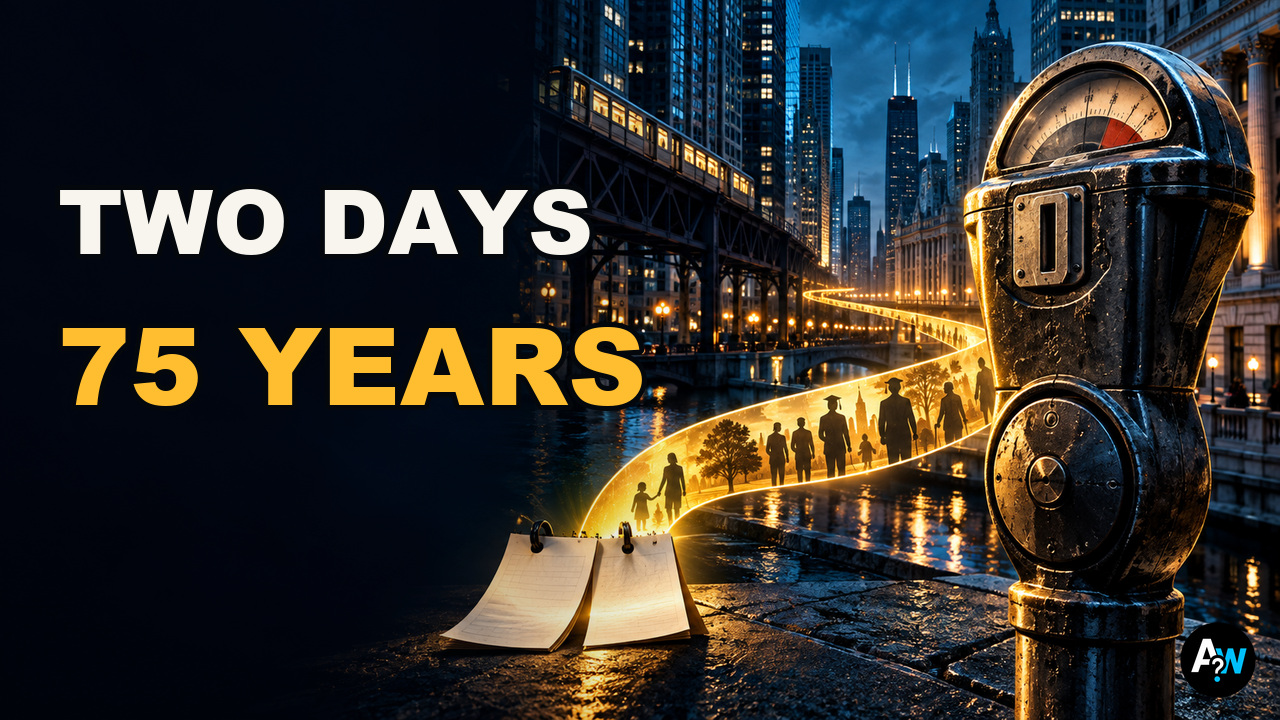
Premieres October 26, 2026 at 8:00 PM CDT. The video will play here after its scheduled YouTube release.
Read the evidence, decisions, and consequences behind this investigation.
The question: Tuesday to Thursday
Why Did Chicago Approve a Seventy-Five-Year Parking Meter Lease in Just Two Days?
On Tuesday, December second, two thousand eight, Mayor Richard M. Daley's administration publicly revealed the final terms of a deal covering roughly thirty-six thousand metered parking spaces.
The term was seventy-five years. The price was one upfront payment of exactly one billion, one hundred fifty-six million, five hundred thousand dollars.
On Thursday, December fourth, the Chicago City Council approved the concession forty to five. Between disclosure and approval, the proposal received one Finance Committee hearing and no dedicated public hearing for residents.
The city had compared competing bids. But Chicago's inspector general later found that the officials advising the Council had not calculated what keeping the meter system would be worth under comparable terms.
Chicago knew the size of the check. It had not priced the future it was giving up.
Cash Now
Chicago entered the financial crisis facing a severe budget problem. Daley's administration presented the meter payment as a way to support the budget and avoid raising property taxes during a recession.
That made the deal politically powerful. A tax increase asks residents for more money now. A concession looked like the reverse: a private group would hand Chicago more than a billion dollars.
But the money was not free. Chicago was converting a stream of future meter collections into one present-day check.
The distinction matters. Chicago did not sell its streets. The agreement gave Chicago Parking Meters, L L C, the right to operate, maintain, and improve the metered-parking system and collect its meter revenue for seventy-five years. LAZ Parking was designated as the operator.
The city retained primary parking enforcement, police powers, and authority over rates and hours within the contract. That meant Chicago still had public responsibilities—but future choices could carry private financial consequences.
The administration also had a reason to trust the number on the table: it had run a competitive bidding process and compared bids.
But bidders were answering, “What will we pay?” Chicago had not answered the different question: “What is this worth if we keep it?”
The Two-Day Decision
Internal planning and bidding had taken place before December second. The two-day clock describes the public and Council review of the final terms, not the entire history of the idea.
That difference does not make the clock less important. It makes it more precise.
The final package combined a seventy-five-year term, scheduled rate increases, operating rules, and provisions that could affect street decisions for decades. Aldermen were being asked to judge all of that while the immediate reward—a billion-dollar payment during a budget crisis—was obvious.
The long-term cost was harder to see because it was spread across roughly thirty-six thousand parking spaces and seventy-five future years.
On December fourth, forty aldermen said yes and five said no. The ordinance passed before Chicago had commissioned the kind of retained-system valuation that could place the upfront bid beside the value of decades of future net revenue.
This is the decision point at the center of the story. The mistake documented later was not simply choosing the wrong number. It was approving the bargain without producing the comparison needed to know what the right number might be.
The Contract Reaches the Curb
Drivers did not need a financial model to notice what happened next.
Under the scheduled increases, the hourly rate in Chicago's Loop rose from three dollars in two thousand eight to six dollars and fifty cents by two thousand thirteen. Those increases were part of the concession's rate schedule, not a surprise price invented by the operator after signing.
The transition was also disorderly. Residents encountered meters and pay boxes that were broken, frozen, overfilled, or improperly calibrated. Daley later acknowledged that the handoff should have been phased over three to six months.
Then there was the contract behind the hardware.
If metered spaces became unavailable because of certain construction, festivals, transit changes, or other city actions, the agreement's compensation mechanisms could require Chicago to preserve the concessionaire's economic position. The exact trigger and calculation depended on the clause; it was not as simple as “cover a meter, write a check.”
Still, the basic tension was real. A later mayor or council might want to change a curb for a bus lane, a public event, or another civic purpose. The government retained authority to act, but the concession could attach a cost to that choice.
The billion-dollar check had purchased budget relief. It had also tied public street decisions to a private revenue contract.
The Watchdog Prices the Future
In June two thousand nine, Chicago's Office of Inspector General published the comparison the city had not performed before approval.
Using a seven-percent discount rate along with the agreement's rate schedule and operating assumptions, the inspector general estimated that retaining the system for seventy-five years was worth about two point one three billion dollars to the city. That was roughly nine hundred seventy-four million dollars more than the payment Chicago accepted.
That does not mean someone later opened an account and found nine hundred seventy-four million dollars missing. The result was a model, not an audited cash loss or a court award. Change the assumptions—future collections, expenses, or the discount rate—and the estimated value changes.
The stronger finding was about process. Chicago had not built its own comparable valuation before asking the Council to commit.
The inspector general also modeled shorter leases with revenue sharing. In its analysis, those alternatives could have supplied near-term budget relief while allowing Chicago to surrender less of the system's future value.
Those options were hypothetical. There is no guarantee the market would have delivered every modeled dollar on the city's preferred terms. But they show why the missing analysis mattered: the choice was not necessarily “take this exact deal or raise taxes.”
A Check Ends; a Contract Does Not
Chicago allocated the concession's net proceeds among long-term and mid-term reserves, budget stabilization, and human-infrastructure programs. Much of the principal designated for budget support was then consumed in the first years after the deal.
That was the asymmetry. The city could spend today's check only once. The private right to collect meter revenue continued for the concession term.
NBC Chicago's review of annual audits reported that, by the end of two thousand twenty-four, the concession had generated roughly two billion dollars in gross meter revenue. Gross revenue is not profit: it does not subtract operating costs, financing, taxes, or other obligations, and it cannot be compared directly with Chicago's two-thousand-eight payment as though the figures were identical.
But the continuing collections made the duration visible. The original mayor left office, Council membership changed, and later administrations argued over compensation and street policy while the concession remained.
Then, in two thousand twenty-six, a new price appeared.
Stonepeak Partners offered a reported two point five three billion dollars to acquire the ownership interests in Chicago Parking Meters from the incumbent investors. That price is not proof that Chicago “lost” the difference between two point five three billion dollars and its original check; the remaining term, meter rates, cash flows, financing, and risk were all different in two thousand twenty-six.
Chicago explored buying the concession interests back and submitted a higher reported bid, but the city abandoned that effort after judging the financing and downside risks too great.
Eighteen years after taking the check, Chicago judged that it could not reverse the transaction without taking another enormous financial risk.
The 2026 Bargain
On September twenty-ninth, two thousand twenty-six, the City Council approved the proposed Stonepeak ownership-interest transfer forty-six to three.
This time, Chicago negotiated around the transfer. If the transaction closes under the Council-approved package, the city would receive a seventy-five-million-dollar payment, five percent of annual calculated net income, two percent of qualifying future transfer compensation, and limited relief for specified event closures.
Those changes would improve Chicago's position, but they would not return the meters to city operation. The concession remains scheduled to continue through two thousand eighty-four.
One figure connected the two votes. Scott Waguespack was among the five aldermen who opposed the deal in two thousand eight, and he helped negotiate the city's concessions in two thousand twenty-six.
In two thousand eight, the Council had two days between public disclosure and approval of the final bargain. In two thousand twenty-six, the city was negotiating for a percentage of income from a meter system it once controlled.
That is what a seventy-five-year decision means. The people who make it do not have to remain in office for the contract to keep making decisions after them.
The answer: Borrowing From the Future
So, why did Chicago approve a seventy-five-year parking meter lease in just two days?
Because a recession-era budget emergency made a one-point-one-five-six-five-billion-dollar upfront payment immediately useful and politically attractive, while the compressed public review let that short-term need outrun a serious comparison with the system's long-term value.
Chicago compared buyers. It did not first price the choice to remain the owner.
The result was a bargain that relieved one immediate budget crisis, then carried rate increases, revenue rights, and constraints on future street choices across multiple administrations.
Chicago did not merely lease parking meters. It borrowed from the future without calling the transaction a loan.
Stay sharp, Stay curious. And always ask why, guys.
Follow the record.
What did this story make you question?
Comments are reviewed before they appear publicly. Your email is optional and never published.