
Why Did Southwest Cancel 16,700 Flights Over Christmas?
Extreme winter weather overwhelmed two crucial operating locations, then cascading cancellations outran Southwest's ability to reconnect aircraft, crews, and flights until it cut the schedule to rebuild the network.
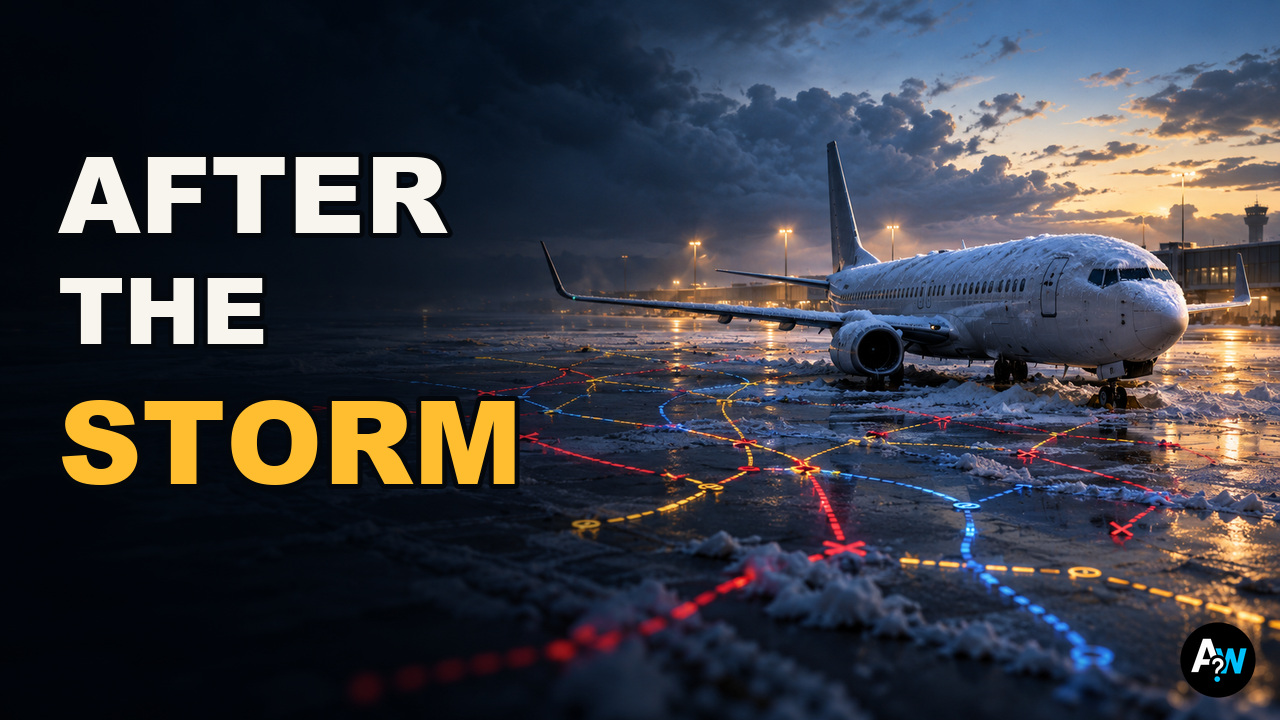
Premieres October 22, 2026 at 8:00 PM CDT. The video will play here after its scheduled YouTube release.
Read the evidence, decisions, and consequences behind this investigation.
The question: When the Storm Moved On
Why Did Southwest Cancel Sixteen Thousand Seven Hundred Flights Over Christmas?
A vast Arctic outbreak and winter storm hit the United States just as millions of people were trying to travel for the holidays. Airlines canceled flights across the country. But as competing carriers began to recover, Southwest kept collapsing.
From December twenty-first through December thirty-first, two thousand twenty-two, Southwest canceled more than sixteen thousand seven hundred flights. The Transportation Department says the disruption affected more than two million passengers.
The storm was real. It was also only the trigger.
By Christmas Eve, Southwest's chief operating officer said the weather event had become a crew-scheduling event. The airline could no longer reconnect enough airplanes with the pilots and flight attendants needed to fly them.
So Southwest made an extraordinary choice: cancel most of its remaining schedule, move crews and aircraft into place, and rebuild a smaller airline it could actually operate.
An Airline Built to Keep Moving
At the end of two thousand twenty-two, Southwest operated seven hundred seventy Boeing seven thirty-sevens and served one hundred twenty-one destinations. Its network offered extensive point-to-point flying rather than relying only on a few giant connecting hubs.
That model was not, by itself, the proven cause of the collapse. Both Southwest and its pilots' union defended the basic network while disagreeing sharply about the airline's ability to recover from disruption.
Whatever the route map looks like, every airline must keep three versions of reality aligned: the published flight schedule, the location of each aircraft, and the location and legal availability of each crew.
On an ordinary day, those pieces move together. A plane lands, a crew continues or changes, and the next flight leaves. But after a cancellation, the aircraft may be in one city, its next crew in another, and the passengers in a third.
One cancellation can be repaired. Thousands of close-in changes create thousands of new questions at once.
Southwest had seen warning signs before Christmas two thousand twenty-two. Its pilots' union says it had warned about crew-scheduling technology and processes since two thousand fourteen, and a separate October two thousand twenty-one disruption had canceled more than two thousand two hundred flights. Southwest disputes the broader claim that chronic technology underinvestment or the point-to-point model caused the two thousand twenty-two collapse.
That disagreement matters. This is not a story about one ancient computer suddenly switching off.
The Winter Plan Meets Worse Weather
The crisis began on December twenty-first as Arctic air and a major winter storm spread across the country. Southwest pre-canceled flights based on what it believed each station could handle.
Then conditions at Denver and Chicago Midway became worse than the airline had expected. Both airports were major Southwest crew bases, so trouble there did not stay there.
In Chicago, the National Weather Service recorded powerful winds, blowing snow, and extreme cold, including a high below zero on December twenty-third. Southwest later described deicing constraints, frozen equipment, limited safe outdoor working time, and disrupted aircraft flows.
The airline's winter plan had assumed those stations could keep processing a certain amount of work. Once the real conditions pushed them below that level, Southwest canceled more flights close to departure.
Every new cancellation changed where a plane would finish, where a crew would finish, who was still within legal duty limits, and which flight could operate next.
The schedule was no longer merely delayed. It was starting to describe a version of the airline that no longer existed.
Weather Becomes a Crew Crisis
By December twenty-fourth, according to Southwest chief operating officer Andrew Watterson, the company had crossed that line: the weather event had become a crew-scheduling event.
Pilots and flight attendants were displaced from assigned trips. Crew phone lines and hotel processes overloaded, while employees and schedulers relied on time-consuming manual work to rebuild assignments.
Southwest says its established recovery tools and processes were overwhelmed by an unprecedented volume and pace of changes. The Southwest Airlines Pilots Association gives a harsher account: it says years of warnings, inadequate processes, and underinvestment left the airline unable to use available crews efficiently.
Those are interested accounts, not interchangeable findings. But they describe the same visible failure: the operation could not turn its available people and aircraft into a reliable schedule quickly enough.
The strangest image of the recovery came from empty airplanes. The union told Congress that Southwest operated five hundred seventeen ferry flights to reposition aircraft and crews while passengers were still waiting.
That count remains the union's claim. But the logic is revealing: before an airline can carry tomorrow's passengers, it may have to fly today's empty plane to the city where tomorrow's crew and route can use it.
Southwest was no longer trying only to save individual flights. It was trying to make the map of its operation match reality again.
Make the Airline Smaller
On December twenty-sixth, Southwest chose the reset. For several days, it planned to operate roughly one-third of its schedule, canceling much of the rest so crews and aircraft could be repositioned into a pattern the recovery operation could manage.
For a traveler holding a canceled ticket, this was more failure. For the people rebuilding the network, it was a way to stop feeding the cascade.
A full schedule is useful only if the airline knows it can staff and fly it. By shrinking the plan, Southwest reduced the number of moving parts and created room to reunite aircraft, legal crews, and workable trips.
This was the central decision point of the collapse. Southwest accepted a deeper burst of cancellations because continuing to promise flights it could not reliably assemble would keep making recovery harder.
Southwest returned to what it called a normal operating schedule on December thirtieth. Its Securities and Exchange Commission filing later recorded more than sixteen thousand seven hundred cancellations across the December twenty-first-to-thirty-first window.
That is the number in the title. The Transportation Department later used sixteen thousand nine hundred for a broader holiday period extending into the New Year, so the two totals describe different windows.
Company Versus Union
Restoring flights did not settle why the collapse had happened.
Southwest's own review described a chain of failures: unexpectedly severe weather, inadequate winter preparation in key places, too many close-in cancellations, overloaded station operations and crew processes, communication problems, and recovery tools that could not absorb the pace of change.
The pilots' union argued that management had been warned for years and had not invested enough in the processes and technology needed to recover crews. Southwest chief executive officer Bob Jordan rejected the idea that the company had simply starved technology or that its route network was the root cause.
The evidence does not require choosing between “only weather” and “only software.” Weather created the disruption; weaknesses in preparation, coordination, communication, and crew recovery determined how far it spread and how long Southwest remained broken.
Southwest responded with changes that included more deicing and winter equipment, greater crew-call capacity, upgraded crew-recovery tools, new operational dashboards, and a larger two thousand twenty-three technology budget.
Those investments do not retroactively prove every union accusation. They do show that Southwest's own answer went far beyond waiting for better weather.
The Bill Arrives
The financial damage came in layers.
Southwest estimated that the disruption reduced its fourth-quarter two thousand twenty-two pretax results by about eight hundred million dollars. That included roughly four hundred ten million dollars in lost operating revenue and a net three hundred ninety million dollars in added operating expenses, including reimbursements, goodwill points, and employee compensation.
The aftereffects continued into the first quarter of two thousand twenty-three, when Southwest estimated another three hundred eighty million dollars of pretax impact from booking weakness and added costs. Those period-specific figures overlap with several forms of customer compensation, so they cannot all be piled together as one simple cash-loss number.
The Transportation Department later found numerous failures involving prompt or proper refunds, flight-status notifications, and adequate customer-service assistance. It said passengers had received more than six hundred million dollars in refunds and reimbursements.
In two thousand twenty-three, the department announced a one-hundred-forty-million-dollar civil-penalty structure—but that was not one hundred forty million dollars paid in cash to the government. The order included thirty-five million dollars in scheduled Treasury payments, a seventy-two-million-dollar offset tied to a future passenger-compensation system, and a thirty-three-million-dollar credit for goodwill points.
The department also closed its inquiry into whether Southwest had scheduled an unrealistic number of flights without making a finding on that question.
The Bill Arrives, Continued
Then, in December two thousand twenty-five, the Transportation Department credited the final eleven-million-dollar Treasury installment after Southwest documented a one-hundred-twelve-point-four-million-dollar investment in its Network Operations Control and improved completion and on-time performance.
That does not prove every weakness is gone. It closes the regulatory arc with a measurable investment in the part of the airline responsible for keeping the operation connected.
The answer: The Storm Was the Trigger
So, why did Southwest cancel sixteen thousand seven hundred flights over Christmas?
Because extreme winter weather overwhelmed two crucial operating locations, then cascading cancellations outran Southwest's ability to reconnect aircraft, crews, and flights. Once the published schedule drifted too far from the real location and availability of its people and planes, Southwest had to cancel most of the plan and rebuild from a smaller one.
The storm started the crisis. Inadequate winter resilience and an overwhelmed crew-recovery operation turned it into Southwest's crisis.
An efficient system is not resilient merely because it performs well on an ordinary day. Its real test is whether it can find its people, understand its machines, and make a new promise when the old plan collapses.
Stay sharp, Stay curious. And always ask why, guys.
Follow the record.
What did this story make you question?
Comments are reviewed before they appear publicly. Your email is optional and never published.