
Why Did Disney Abandon Its American History Theme Park Before It Was Built?
Disney won a favorable local recommendation for Disney's America, then left Haymarket one week later as the proposed history park remained trapped in a wider fight over development, historic land, and public trust.
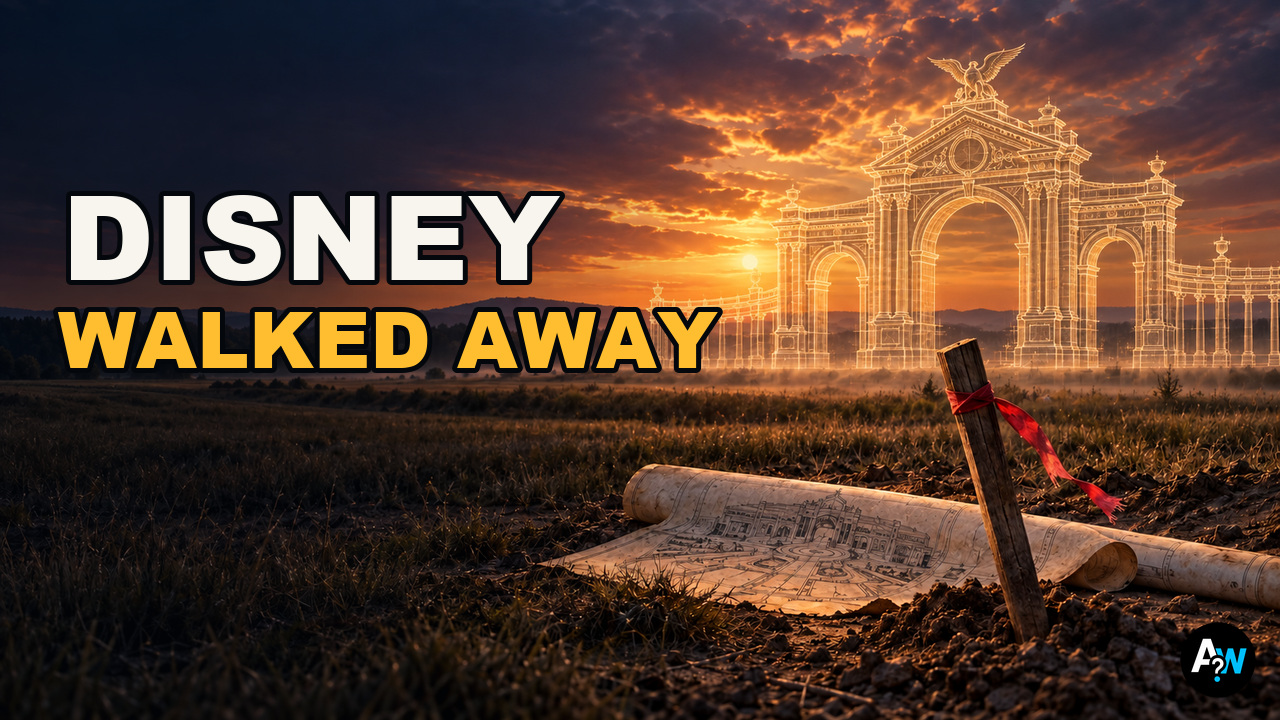
Premieres October 5, 2026 at 8:00 PM CDT. The video will play here after its scheduled YouTube release.
Read the evidence, decisions, and consequences behind this investigation.
The question: Disney Wins, Then Walks
Why Did Disney Abandon Its American History Theme Park Before It Was Built?
In September nineteen ninety-four, Disney looked as if it had finally broken through. A local planning commission had just recommended approval for Disney's America, a reported six hundred fifty million dollar park near Haymarket, Virginia.
Virginia's political leadership had backed the project, and the General Assembly had approved a reported one hundred sixty-three point two million dollar support package. Then, one week after that favorable planning vote, Disney told the governor it was walking away from the site.
The government had not rejected Disney. Disney's public statement and contemporary reporting instead point to a cumulative national fight over traffic, development, Civil War landscapes, public support, and whether a corporation famous for fantasy could be trusted with the country's hardest history.
The favorable vote moved the project forward, but it did not resolve that conflict.
Eisner's American Adventure
Michael Eisner later traced the idea back to a nineteen ninety-one visit to Colonial Williamsburg with Disney parks chief Dick Nunis and Disney president Frank Wells. Disney then spent roughly two years searching the Washington region before announcing Disney's America on November eleventh, nineteen ninety-three.
The pitch was bigger than another castle and roller coaster. Disney said it wanted to turn American history into an immersive, one-day park that could confront conflict as well as celebrate achievement. The company publicly discussed difficult subjects including slavery, war, immigration, industry, and political struggle, although individual attraction concepts changed as the plan evolved.
That ambition gave the project its power. It also created its first problem.
Disney was not merely proposing entertainment. It was taking on the role of interpreting a national story—and packaging that story for millions of paying visitors.
The park itself was initially described as roughly one hundred acres, but it sat inside a much larger development plan covering about three thousand acres near Haymarket in Prince William County. Contemporary plans included hotels, housing, golf, retail, offices, recreation, and infrastructure around the attraction.
So when Disney described a history park, people living nearby saw something else too: a massive real-estate and infrastructure project.
The Site Becomes the Story
The proposed land was private property outside Manassas National Battlefield Park. But it was only several miles from the park, amid countryside connected to Civil War history.
The documented fight was not over paving the protected battlefield park itself. Opponents argued that the resort, homes, offices, hotels, roads, and traffic surrounding the park could accelerate development across a broader historic landscape.
Supporters saw the same growth and reached the opposite conclusion. They pointed to projected jobs, tourism, tax revenue, and road improvements, and argued that development was coming to the region whether Disney built there or not.
The community was divided, not uniformly hostile. Some residents wanted the opportunity Disney promised; others feared the scale of what would follow it.
Disney had selected a place where the physical location could not be separated from the story it wanted to sell. A park about American memory was now fighting over American memory before it had poured concrete.
Virginia Places Its Bet
Governor George Allen became a prominent supporter, and Virginia lawmakers approved a reported one hundred sixty-three point two million dollar package connected to the project in March nineteen ninety-four.
That number needs care. It was not simply a one hundred sixty-three point two million dollar check handed to Disney. The package covered a mix of public commitments. Within that broader package, enacted Virginia law authorized up to forty-nine point one four three million dollars in transportation revenue bonds for specified interchanges, connector roads, studies, design, land, and construction.
In other words, Virginia was not buying rides. It was betting that public infrastructure and support would unlock a much larger economic project.
But every public commitment raised the price of being wrong. The larger the plan appeared, the harder it became to discuss Disney's America as just a theme park.
Disney's own projections shifted as the proposal developed. A Washington Post chronology reported that by January sixth, nineteen ninety-four, the forecasts had grown to two thousand five hundred residences, nearly two million square feet of office space, and seventy-seven thousand daily automobile trips.
To supporters, those forecasts could represent managed growth. To opponents, they looked like proof that the history park was the front door to an enormous development.
The Opposition Goes National
Local preservationist Annie Snyder already had experience fighting development around Manassas through the Save the Battlefield Coalition. The National Trust for Historic Preservation opposed the project, while a new group called Protect Historic America drew prominent historians and writers into the dispute.
David McCullough became one of the most visible critics. The opposition challenged both the development footprint and Disney's ability to dramatize slavery, war, and other painful subjects without trivializing them.
Those were related arguments, but they were not identical. One was about land use: traffic, roads, subdivisions, and the cumulative effect on historic countryside. The other was about authority: whether Disney's talent for simplifying stories into attractions was a strength or a liability when the story was the United States.
Nor was the opposition above criticism. Project supporters accused some preservationists of elitism, not-in-my-backyard politics, and protecting their own interests while resisting growth that could benefit other residents.
That is what made the conflict so difficult for Disney. There was no single demand it could satisfy. Shrinking one attraction would not settle the traffic fight. Promising serious scholarship would not settle the development fight. And political support could not manufacture public trust.
A Victory That Solved Nothing
As the fight intensified, Eisner publicly sounded determined to continue. Yet Disney still faced a long approval process involving local, regional, state, and federal authorities.
On September twenty-first, nineteen ninety-four, the Prince William County Planning Commission recommended zoning approval. Regional transportation officials also authorized major road projects serving the development.
From a distance, that looked like victory. But it was only one step. The Los Angeles Times reported that the overall project still faced more than seventy approval stages across roughly three dozen agencies.
On September twenty-eighth, Disney executives told Governor Allen the company would abandon the Haymarket location. Disney's public statement said the controversy was diverting attention and resources from developing the project and that it could not allow a particular site to turn a hoped-for source of unity into divisiveness.
The timing was the whole story: Disney withdrew not after a decisive government defeat, but one week after a favorable local recommendation.
Why Disney Really Left
There is a tempting, simple explanation: preservationists defeated Disney. But the strongest supported explanation is more cumulative.
The Haymarket project still faced many approvals, escalating traffic and development arguments, a national campaign by respected historians, and a growing threat to Disney's reputation. The company was trying to sell a unifying encounter with American history while the proposed site had become a symbol of division.
Disney also had financial pressure elsewhere. Euro Disney was struggling at the time, and contemporary reporting placed that trouble in the background of Disney's broader parks decisions. But the available record does not establish Euro Disney as the single reason Haymarket was abandoned.
Disney's own public explanation emphasized controversy, diverted resources, uncertain timing, and the damage of tying the concept to one divisive location.
So the decision was not simply, “Can we get permission to build?” It was, “What will it cost us to keep proving that we should?”
Disney still had allies in Richmond and support within the community. What it no longer had was a credible path to make this particular site feel like the neutral home of a national story.
The Park That Went Nowhere
Disney insisted that it was leaving Haymarket, not abandoning the entire concept, and said it would search for another Virginia location. No replacement site was selected.
By March nineteen ninety-five, Disney had put roughly six hundred acres it owned near Haymarket up for sale and relinquished purchase rights covering another two thousand thirty-seven acres.
Disney's official historical account now says no further work was done on Disney's America.
The withdrawal did not freeze the region in nineteen ninety-four, and it does not prove that stopping Disney permanently stopped development around Haymarket. What it did prove was that official momentum is not the same thing as public legitimacy.
The answer: Permission Was Not the Product
So, why did Disney abandon its American history theme park before it was built?
The best-supported answer is that Disney concluded the Haymarket site had turned a reported six hundred fifty million dollar entertainment project into a prolonged fight over development, historic land, public support, and the company's right to interpret American history—and that winning approvals could still leave the park without the trust it needed to succeed.
Disney was selling more than admission. It was selling confidence that it could tell a shared national story. Once the location itself made that promise look divisive, walking away became safer than winning.
Stay sharp, Stay curious. And always ask why, guys.
Follow the record.
The complete research, fact-checking, and attribution records are preserved with this production. Public source links will be added during a future editorial source pass.
What did this story make you question?
Comments are reviewed before they appear publicly. Your email is optional and never published.