
Why Did One Tiny Math Error Cost Intel $475 Million?
A rare Pentium division flaw became a $475 million accounting charge after Intel's needs-based replacement policy collided with customer trust and IBM halted shipments.
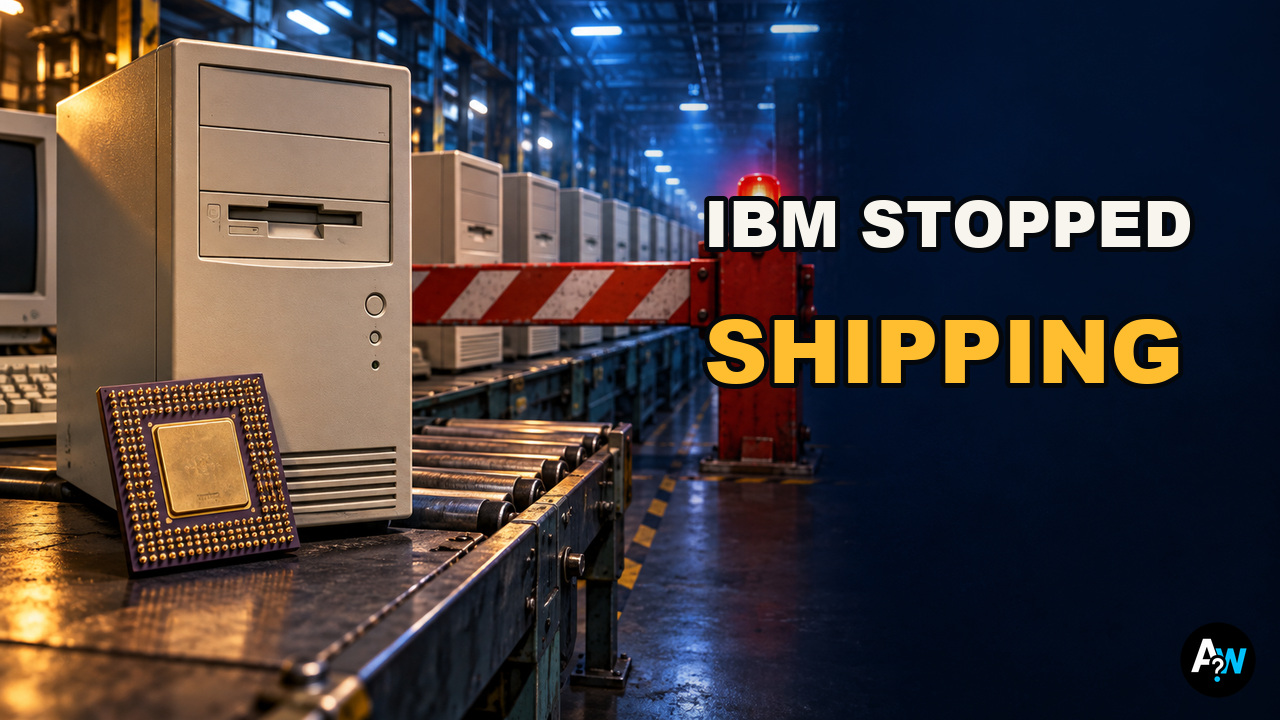
Premieres October 1, 2026 at 8:00 PM CDT. The video will play here after its scheduled YouTube release.
Read the evidence, decisions, and consequences behind this investigation.
The question: The Most Expensive Wrong Answer
Why Did One Tiny Math Error Cost Intel Four Hundred Seventy-Five Million Dollars?
In nineteen ninety-four, Intel's new Pentium processor could return the wrong answer for certain division problems.
Under Intel's random-pair estimate, the flaw was rare. It did not break every Pentium, or even every division calculation.
But Intel's first response made the problem much bigger: the company would replace a chip only after deciding that its owner's needs required a replacement.
Then IBM stopped shipping most of its Pentium computers. Eight days later, Intel reversed course and offered any concerned owner a replacement on request.
The accounting consequence was a one-time, four-hundred-seventy-five-million-dollar pretax charge covering the exchange program, replacement material, and older inventory write-downs.
So this was never just a story about a microscopic defect inside a chip. It became a fight over a much larger question: after Intel marketed processor quality directly to the public, who got to decide how accurate was accurate enough?
Act One — Intel Comes Out of the Box
Intel launched the original Pentium in nineteen ninety-three as the high-performance successor to its four eighty-six line.
For years, most buyers had paid attention to the company whose name was printed on the outside of a personal computer. Intel made a component hidden inside it.
The Intel Inside campaign changed that relationship by encouraging ordinary buyers to look for Intel's name when choosing a computer.
That was an extraordinary branding victory. It also created an obligation Intel was about to discover the hard way. If the processor was important enough to influence the purchase, its maker was visible enough to receive the complaint.
Pentium was marketed as a major leap in computing performance, including faster floating-point work—the kind of calculation used for numbers that are not tidy whole integers.
And during nineteen ninety-four, it was becoming a commercial success. Intel would finish the year with record revenue of eleven point five two billion dollars, up thirty-one percent from nineteen ninety-three.
Then a mathematician in Virginia noticed that the computer did not always agree with itself.
Act Two — Thomas Nicely Finds the Crack
Thomas Nicely was a mathematics professor at Lynchburg College studying reciprocals connected to prime numbers.
In June nineteen ninety-four, calculations on his Pentium systems began producing small but persistent inconsistencies.
He did not immediately accuse the processor. Over the next several months, he tested software, hardware, and different machines, trying to eliminate more ordinary explanations.
On October thirtieth, Nicely circulated a warning describing a flaw in the Pentium's floating-point division operation.
Other users reproduced the problem. One example, credited in the contemporaneous record to engineer Tim Coe, divided four million one hundred ninety-five thousand eight hundred thirty-five by three million one hundred forty-five thousand seven hundred twenty-seven and made the wrong result visible on an ordinary Pentium system.
That mattered because “rare processor erratum” sounds remote. A reproducible division problem that anyone could type into a computer feels personal.
According to contemporaneous reporting, Intel engineers had independently identified the flaw in June and corrected later production. The company did not publicly disclose it because it judged an ordinary user's chance of encountering it to be extremely small.
In plain language, the processor used a table to help choose the next step in a fast division method. Five entries that should have contained values were omitted, so a narrow set of inputs could send the calculation down the wrong path.
The bug was real, limited, and technically explainable. The approaching disaster came from believing that those three facts settled the matter.
A wrong answer does not arrive with a warning label explaining how unlikely it was. It simply looks like the computer's answer. For a mathematician, engineer, or scientist, that creates a second problem: if one result is wrong, which other result should be trusted? The rarity of the defect could limit how often that question appeared. It could not answer the question once it did.
Act Three — Intel Does the Probability Math
Intel said the flaw could reduce precision for one out of every nine billion pairs of randomly chosen numbers.
That estimate did not mean every user would encounter the bug once every nine billion divisions. Real workloads are not random-number lotteries.
Still, Intel believed the practical risk for most owners was tiny.
So its original replacement approach was based on need. Intel would discuss the customer's work and determine whether that customer's needs required a replacement.
From an engineering and logistics perspective, that could look rational: why replace processors over a condition most people might never see?
From the customer's side, it sounded very different: Intel had sold a premium processor on performance and quality, then reserved the right to judge whose work justified a replacement.
That policy also placed the burden of uncertainty on the buyer. The customer had to predict future workloads, understand an obscure arithmetic defect, and persuade Intel that the risk applied. Intel already knew the corrected chip existed. The argument was no longer only about frequency. It was about who had to live with the doubt.
The story spread through early Internet discussion groups and then major news outlets, while repeatable examples turned an invisible silicon flaw into a wrong answer on the screen.
Intel was answering with probability. Customers were asking about trust.
And then another computer giant entered the argument.
Act Four — IBM Changes the Stakes
On December twelfth, nineteen ninety-four, IBM announced that it was suspending shipments of most Pentium-based personal computers.
IBM said its own testing suggested the flaw could appear more often in common spreadsheet-style work than Intel's public framing implied.
Those estimates should not be treated as two measurements of the same thing: Intel modeled random number pairs, while IBM modeled particular workloads.
IBM was not a neutral bystander. It also had an interest in the competing PowerPC architecture. But no theory about IBM's motive is needed to see the consequence.
Intel chief executive Andy Grove said IBM's action reignited customer calls and changed the emotional force of the crisis.
Now the argument was no longer Intel versus a few specialists. One of the most recognizable names in personal computing had decided it could not keep shipping most of the affected machines.
The needs test became impossible to defend as a customer-service policy. The owner of the chip no longer wanted Intel to calculate the odds. The owner wanted the choice.
Act Five — No Questions Asked
On December twentieth, Intel changed its policy.
The company offered a lifetime exchange to any Pentium owner concerned about the flaw, without requiring that person to prove a technical need.
Grove apologized and acknowledged that Intel's earlier stance had appeared arrogant and uncaring.
Intel offered direct replacement, technical assistance, no-charge service options, and coordination with computer manufacturers.
The new policy did something the probability estimates could not: it let the owner decide whether peace of mind justified an exchange. Intel, not the customer, would now absorb the uncertainty created by Intel's product.
This was not a government fine, and Intel's own filing described an upon-request exchange—not a mandatory recall of every system.
On January seventeenth, nineteen ninety-five, Intel reported a one-time four-hundred-seventy-five-million-dollar pretax charge associated with the replacement program.
The company said the charge covered replacement costs, replacement material, and the write-down of inventory containing earlier versions of the chip.
That distinction matters. The number was not a verified pile of cash handed to harmed customers. It was an accounting charge for the exchange and the inventory consequences of Intel's reversal.
And the reversal did not destroy Pentium. Intel said current shipments had moved to the updated version, while Pentium unit shipments approximately doubled from the previous quarter.
Even after the charge, Intel posted record annual revenue.
The product survived. The original policy did not.
Act Six — What Actually Cost Four Hundred Seventy-Five Million Dollars
So why did one tiny math error cost Intel four hundred seventy-five million dollars?
Because Intel had spent years turning its hidden component into a public promise, then responded to a correctness failure as if it were still only a technical specification.
The defect affected a narrow set of floating-point divisions. But the needs-based policy asked customers to let Intel decide whether their work justified a replacement.
Nicely made the error reproducible. The Internet and major media made it visible. IBM made it commercially urgent.
Intel's eventual answer was to give the decision back to the customer—and absorb the replacement and inventory consequences.
The lesson is not that every Pentium was constantly doing bad math, or that the bug ruined Intel.
It is that once a company puts its name on trust, probability alone cannot repair a promise. The error lived in silicon. The four-hundred-seventy-five-million-dollar problem lived in who got to decide whether it mattered.
Stay sharp, Stay curious. And always ask why, guys.
Follow the record.
What did this story make you question?
Comments are reviewed before they appear publicly. Your email is optional and never published.