
Why Did Mercedes Recall Its Brand-New A-Class After One Magazine Flipped It?
A fully loaded A-Class overturned during a Swedish magazine’s emergency lane-change test, pushing Mercedes to suspend deliveries and rebuild the car’s dynamics package.
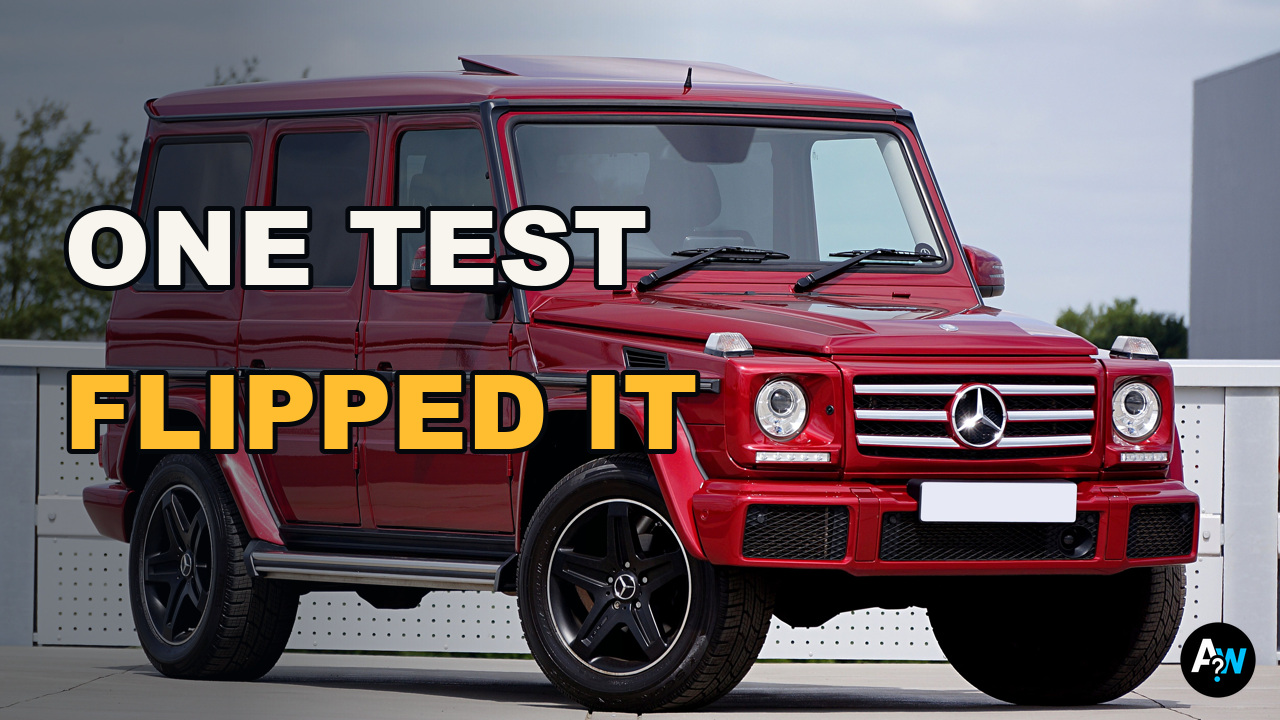
Premieres September 10, 2026 at 8:00 PM CDT. The video will play here after its scheduled YouTube release.
Read the evidence, decisions, and consequences behind this investigation.
The question: The Safety Brand on Two Wheels
Why Did Mercedes Recall Its Brand-New A-Class After One Magazine Flipped It?
On October twenty-first, nineteen ninety-seven, Swedish journalist Robert Collin sent a fully loaded Mercedes A-Class through an emergency double lane change at roughly sixty kilometers per hour, about thirty-seven miles per hour.
The car overturned and came back down on its wheels.
That would have been bad news for any automaker.
For Mercedes, which had tied its safety reputation and future growth to a radically smaller car, it was a public contradiction.
And the test had not come from a government laboratory or a rival manufacturer.
It came from the Swedish magazine Teknikens Värld.
The photographs turned one failed maneuver into a standoff. Mercedes could keep defending the car, or it could stop the launch and rebuild it.
Within weeks, it chose the rebuild.
Act One — Mercedes Goes Small
The first-generation A-Class, known internally as the W one-sixty-eight, was Mercedes-Benz's first front-wheel-drive passenger car.
That made it more than a new model.
Mercedes was moving below its traditional luxury segments and asking buyers to recognize the three-pointed star on a short family car built for city streets.
The engineering answer was an unusual shape: short from bumper to bumper, tall from road to roof, and spacious inside for its footprint.
The space-and-safety concept used what Mercedes called a sandwich floor. In a frontal crash, the engine was intended to move beneath the passenger compartment rather than into it.
It was a clever packaging idea, but it came with a harder assignment.
The whole vehicle still had to remain composed when a driver made a sudden, violent change of direction.
And this distinction matters: the evidence reviewed for this script does not prove that the sandwich floor, or the car's height by itself, caused the rollover.
What the record does show is that Mercedes eventually changed several parts of the dynamics package, not just one.
Act Two — The Test That Looked Ordinary
The popular name is the moose test, but no animal is involved.
The course represents a driver swerving around a sudden obstacle, then returning to the original lane without braking.
The danger is easy to imagine. Something appears in your path, you turn away, and then you turn back before hitting whatever is beside you.
At Bromma, Collin drove with four colleagues and ballast secured in the luggage area, bringing the A-Class to its maximum load.
He later recalled that on a run slightly above sixty kilometers per hour, the car skidded, overturned, struck a roof pillar, and landed back on all four wheels.
Accounts differ on several details, including injuries and how later reports characterized the car's motion. None of those disputed details is needed to understand what Mercedes faced.
The decisive evidence was visual.
Still photographs showed Mercedes's newest small car no longer on four tires.
That made the dispute legible to anyone, including people who had never heard of weight transfer or suspension geometry.
A safety reputation takes decades to build.
One photograph can challenge it in an afternoon.
Act Three — Blame the Test or Change the Car
Collin later recalled that Mercedes first blamed his driving and then the tires.
Period reporting captured a more cautious version of the company's early position. Passenger-car executive Jürgen Hubbert acknowledged design weak points but maintained that the car was safe under normal conditions. He announced tire changes and electronic stability control.
That response created a trap.
If the test was unrealistic, stopping the launch would look like surrender.
But if the car had a genuine weakness under an extreme maneuver, continuing deliveries would put Mercedes's reputation behind a configuration it was already preparing to change.
Then, on November eleventh, Daimler-Benz went further.
It suspended A-Class deliveries, sharply reduced planned production, and committed to retrofit cars already produced or delivered.
Period English-language newspapers called the action a recall. Daimler-Benz's own annual report called it a delivery suspension and retrofit program.
Nothing in the evidence reviewed for this script shows that a regulator ordered it.
The affected-car numbers also depend on what was being counted and when. Contemporary reports separated cars sold, produced, and sent to dealers, while a much later Mercedes retrospective gave a larger delivered-and-upgraded figure.
So this script does not collapse them into one misleading recall total.
The central decision is clear without it. Mercedes stopped the rollout and accepted that the original car needed a broader correction.
Act Four — The System That Brakes One Wheel
The revised A-Class received a repositioned chassis, retuned springs and dampers, new rear stabilizers, different tires, and electronic stability control, or E S P, as standard equipment.
E S P was not invented for this crisis.
Bosch and Daimler had developed the system earlier for the Mercedes S-Class, and Mercedes introduced it in nineteen ninety-five.
In plain language, E S P compares where the driver is trying to point the car with how the car is actually moving.
When those answers diverge, the system can reduce engine torque and brake individual wheels to counter a developing skid.
It is not an anti-rollover force field, and it cannot repeal physics.
Its intervention still depends on the speed, surface, maneuver, and vehicle.
Before the A-Class crisis, the system belonged to the expensive end of the Mercedes range. Now Mercedes needed it as standard equipment on the compact car meant to broaden the brand.
Bosch says the supply response required a second production line for yaw-rate sensors and a twenty-one-shift week, including Sundays.
The fix was not one magic software patch.
It combined mechanical changes, different tires, and active electronic intervention.
That is also why the claim that the car was simply too tall does not hold up. Mercedes kept the basic shape and changed the systems around it.
Act Five — The Car Comes Back
Daimler-Benz restarted A-Class deliveries in February nineteen ninety-eight.
Its annual report said already-produced cars were upgraded in special retrofit centers. It also said independent experts confirmed that the revised configuration handled the extreme lane-change test successfully.
That second claim comes through Daimler-Benz's own report, which did not name the experts or reproduce their findings, so it remains the company's account.
But the commercial result is easier to measure.
By March nineteen ninety-eight, Daimler-Benz reported well over one hundred twenty thousand A-Class orders.
For the full year, DaimlerChrysler reported one hundred thirty-six thousand one hundred A-Class sales.
Orders and sales are different measures, but both show that the rollover did not end the product.
Mercedes had taken the reputational hit, paused deliveries, and returned with a changed car.
The correction protected the larger strategic bet. A Mercedes compact became a real product line instead of a cautionary prototype.
Act Six — From Embarrassment to Standard Equipment
The bigger consequence sat inside the car.
Mercedes-Benz says it began successively making E S P standard across all of its model series in nineteen ninety-nine.
Bosch and Mercedes both describe the A-Class episode as the event that accelerated E S P's breakthrough into the wider market.
That is an interested interpretation from the companies that built and sold the system. But it fits their documented sequence: an upper-end introduction in nineteen ninety-five, standard equipment on the revised compact in nineteen ninety-eight, and broader Mercedes standardization beginning the following year.
The safety case later extended beyond company marketing. A peer-reviewed comparison of otherwise identical vehicle models with and without electronic stability control linked the technology to lower single-vehicle crash involvement in the U.S. data it studied.
Europe eventually required electronic stability control for new vehicle types beginning in November two thousand eleven and for all new vehicles beginning in November two thousand fourteen.
One Swedish rollover did not directly write that law.
It did something more immediate. It made a premium safety system part of the price of saving Mercedes's smallest new car.
The answer: Why Mercedes Recalled the A-Class
So, why did Mercedes recall its brand-new A-Class after one magazine flipped it?
Because the original A-Class could not safely tolerate the abrupt, fully loaded lane change Robert Collin performed.
Mercedes first defended the car and announced limited changes, then decided that protecting the product and its safety reputation required stopping deliveries and rebuilding a broader dynamics package.
The company returned with mechanical revisions, different tires, and E S P as standard, and the A-Class survived.
The failure became famous because the car overturned.
The correction mattered because Mercedes chose to rebuild it.
Stay sharp, Stay curious. And always ask why, guys.
Follow the record.
What did this story make you question?
Comments are reviewed before they appear publicly. Your email is optional and never published.