
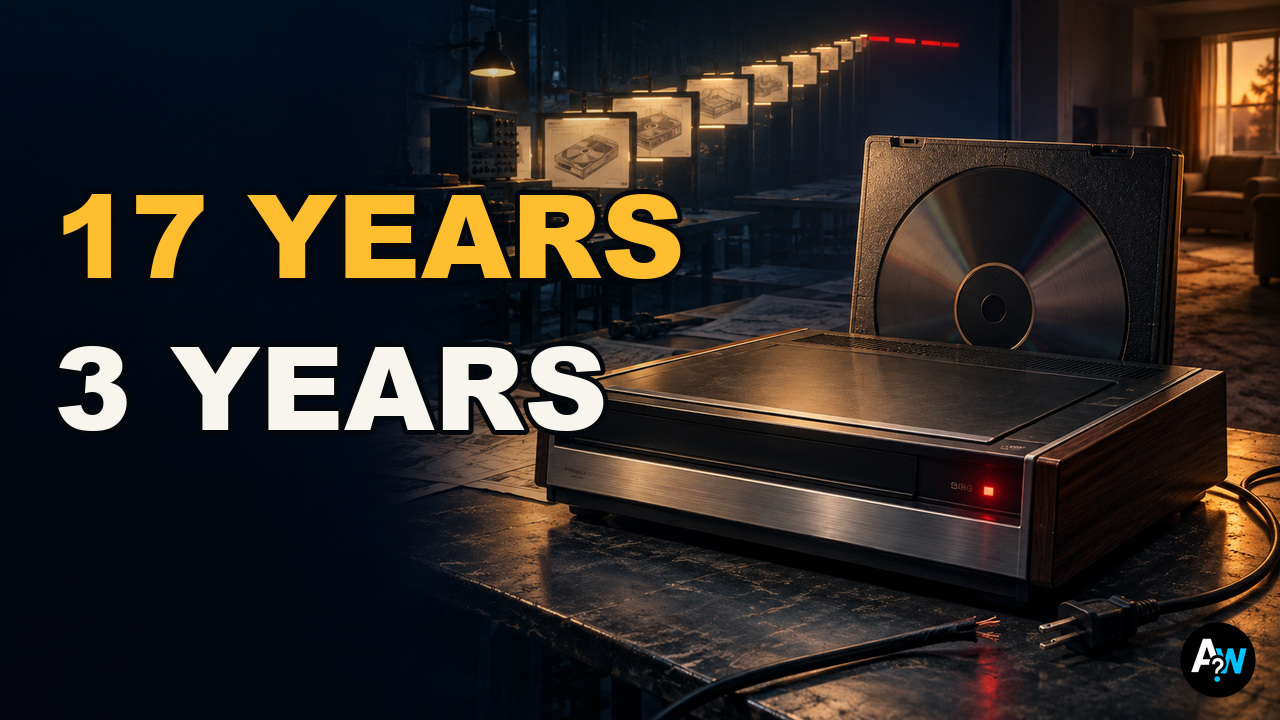
Why Did RCA Spend 17 Years Building a Video Player It Killed Three Years After Launch?
RCA spent 17 years developing an affordable play-only video-disc system, but falling VCR prices and tape rentals erased its advantage within three years of launch.
Premieres September 24, 2026 at 8:00 PM CDT. The video will play here after its scheduled YouTube release.
Read the evidence, decisions, and consequences behind this investigation.
The question: Seventeen Years In, Three Years Out
Why Did RCA Spend Seventeen Years Building a Video Player It Killed Three Years After Launch?
RCA began formal work on its VideoDisc in nineteen sixty-four and launched it nationally in March nineteen eighty-one.
Then, on April fourth, nineteen eighty-four, RCA's board decided to stop making and marketing the players.
Seventeen years to reach the living room. Three years to retreat from it.
By the time RCA pulled the plug, contemporary reports put the venture's losses at five hundred eighty million dollars.
But this was not simply a foolish machine nobody could want.
SelectaVision offered a player for roughly half the price of a typical VCR at launch, with movies on discs that were much cheaper to buy than prerecorded tapes.
RCA had correctly seen a future in which people chose what to watch at home.
Its disaster came from spending so long perfecting one answer that the market changed the question.
RCA Goes Looking Beyond Color
In the nineteen sixties, RCA was one of the American companies most closely associated with radio and television.
After helping make color television a mass-market product, its researchers began looking for another major consumer-electronics system.
In nineteen sixty-four, a small RCA team formally began work on a seductive idea: put prerecorded television and movies on a familiar, mass-producible grooved disc.
The finished Capacitance Electronic Disc, or CED, would look a little like a vinyl record, but its stylus read electrical capacitance rather than mechanically reproducing sound like a phonograph needle.
It was a twelve-inch conductive vinyl disc spinning at four hundred fifty revolutions per minute.
A diamond stylus sensed tiny changes in electrical capacitance encoded in the groove and translated them into a television picture and sound.
The pitch was easy to understand: no threading tape, no complicated controls, and no machine priced like a major appliance.
Load a caddy, let the player pull the disc inside, and watch.
That simplicity was real. Making it reliable was not.
The Disc That Would Not Behave
RCA demonstrated color pictures from the system in nineteen seventy-two.
But a successful demonstration was not the same thing as a product that could survive factories, stores, fingerprints, dust, and repeated play.
The groove had to carry an extraordinary amount of information, the disc material had to remain consistent, and the stylus had to track with extreme precision.
Contamination, scratches, signal degradation, durability, manufacturing yield, and limited playing time kept turning a simple consumer promise into a sprawling engineering problem.
By nineteen seventy-seven, the system reportedly still held only about thirty minutes per side and had unresolved production and durability problems.
RCA president Edgar H. Griffiths scaled the program back and closed the Indianapolis pilot production operation, while basic research continued.
That could have been the ending: an ingenious laboratory system that never became a business.
Instead, in January nineteen seventy-nine, Griffiths reversed course and ordered a rush to market.
The accelerated effort was later described as RCA's Manhattan Project.
The important point is not that RCA ignored every warning.
It is that the company had already spent years overcoming problems that made each new solution feel like progress toward an increasingly reachable finish line.
And while RCA worked toward that line, home video did not wait.
The Biggest Launch Meets a Moving Market
RCA launched SelectaVision nationally on March twenty-second, nineteen eighty-one, through about five thousand dealers.
The S F T one hundred carried a suggested price of four hundred ninety-nine dollars and ninety-five cents.
RCA presented it as affordable, simple, and supported by a broad catalog of prerecorded entertainment.
The forecasts matched the confidence of the launch.
RCA projected at least two hundred thousand players and two million RCA-branded discs in nineteen eighty-one, and described a potential seven point five billion-dollar business after ten years.
Company research, RCA said, suggested VideoDisc had more universal appeal than the VCR.
Just eleven weeks after launch, RCA announced plans to expand its Indianapolis disc operation toward ten million discs of annual production in nineteen eighty-two and eventually thirty million.
This was not a company quietly testing a curiosity. It was building for a mass market.
The first year broke that momentum.
RCA later estimated that the industry sold about one hundred five thousand players at retail in nineteen eighty-one—roughly half its original two hundred thousand-player forecast.
RCA responded with lower-priced models, price cuts, rebates, and continued catalog support.
Those moves mattered because SelectaVision still had a visible advantage: the machine was cheaper than a VCR, and the discs were affordable enough to own.
But consumers were not comparing two machines that did the same job.
Play-Only Versus Record
SelectaVision could play prerecorded discs, but it could not record a television broadcast.
A VCR could play a movie and record tonight's program while its owner was away.
That ability—time-shifting—gave viewers control over television itself, not just a shelf of purchased movies.
At SelectaVision's launch, the tradeoff could still look reasonable.
Contemporary comparisons put RCA's player near five hundred dollars and common VCR prices around one thousand dollars.
If all you wanted was prerecorded entertainment, giving up recording could save hundreds of dollars.
Then the hardware gap narrowed.
By nineteen eighty-four, RCA had cut its least-expensive player to one hundred ninety-nine dollars, but VCRs were being advertised as low as roughly three hundred dollars.
Recording was becoming an extra capability that cost about a hundred dollars more, not a luxury that doubled the price of entry.
And another business had changed the price of the movies themselves.
In nineteen eighty-four, TIME reported roughly fourteen thousand stores renting videotapes for as little as one dollar a day.
The numbers were a dated snapshot, not a universal national price, but the economic change was unmistakable.
A family no longer had to buy an expensive prerecorded tape to enjoy the VCR's catalog.
It could rent the tape, return it, and keep the VCR's recording function.
SelectaVision's cheap discs had been designed to beat the cost of owning movies on tape.
Rental stores made ownership the wrong comparison.
The Advantage Disappears
The market squeeze did not erase SelectaVision's genuine strengths.
Its discs were inexpensive, its picture could beat ordinary broadcast television, and operating the player was deliberately simple.
But the format also carried the burdens of contact playback, a protective caddy, and a shorter maximum playing time than extended-play VHS.
More importantly, it offered fewer ways to get and use entertainment than the VCR ecosystem growing around it.
That is the conflict at the center of the story: RCA kept improving the price of a play-only product while the VCR became a cheaper way to record, rent, and play.
Each SelectaVision price cut defended the original bargain.
Each fall in VCR prices, and each new rental store, made that bargain less important.
RCA had not mistaken the desire for home video.
It had mistaken which part of home video would become decisive.
And RCA could see the rival market from the inside.
TIME reported that by nineteen eighty-four, the company was also the largest United States marketer of VCRs and expected to sell one point five million cassette machines that year.
RCA was not choosing between believing in home video and abandoning it.
It was choosing whether to keep financing the version losing inside its own portfolio.
The Board Stops the Player
On April fourth, nineteen eighty-four, the RCA board decided to end SelectaVision player manufacturing and marketing.
Chairman Thornton F. Bradshaw said “the time has come” to end the player venture.
Contemporary accounts put accumulated losses at five hundred eighty million dollars and RCA's pretax restructuring provision at one hundred seventy-five million dollars.
The Washington Post reported about five hundred thousand players sold from nearly six hundred fifty thousand produced. TIME, reporting later that month, put sales at roughly five hundred fifty thousand. The available reports do not resolve the difference.
The shutdown also carried human stakes at RCA's Bloomington operation, where roughly seven hundred fifty people worked and the company could not yet say exactly how many would be laid off.
But April nineteen eighty-four was not the instant disappearance of every SelectaVision disc.
RCA said it would continue supplying discs for a time, and new releases continued into nineteen eighty-six for people who already owned players.
The board killed the machine business while trying not to abandon its customers overnight.
The answer: Right Future, Wrong Vehicle
So, why did RCA spend seventeen years building a video player it killed three years after launch?
Because the long development solved the physical problems of putting video on a grooved disc, but it could not preserve the economic assumptions that made that disc compelling in the first place.
SelectaVision began as a cheap, simple route to movies at home.
By nineteen eighty-four, falling VCR prices and the rental store had turned recording, time-shifting, renting, and playback into one increasingly affordable system.
RCA predicted the destination correctly: viewers wanted control over what appeared on their televisions.
But seventeen years of commitment locked the company to a vehicle the market had learned to drive around.
The failure was not that RCA arrived at the future too early.
It was that RCA took so long to arrive that the future no longer needed its answer.
Stay sharp, Stay curious. And always ask why, guys.
Follow the record.
What did this story make you question?
Comments are reviewed before they appear publicly. Your email is optional and never published.