
Why Did the Government Buy and Demolish the Entire Town of Times Beach?
Dioxin-contaminated roads, a record flood, and recurring flood risk led authorities to relocate Times Beach permanently and clean the former town for controlled public use instead of housing.
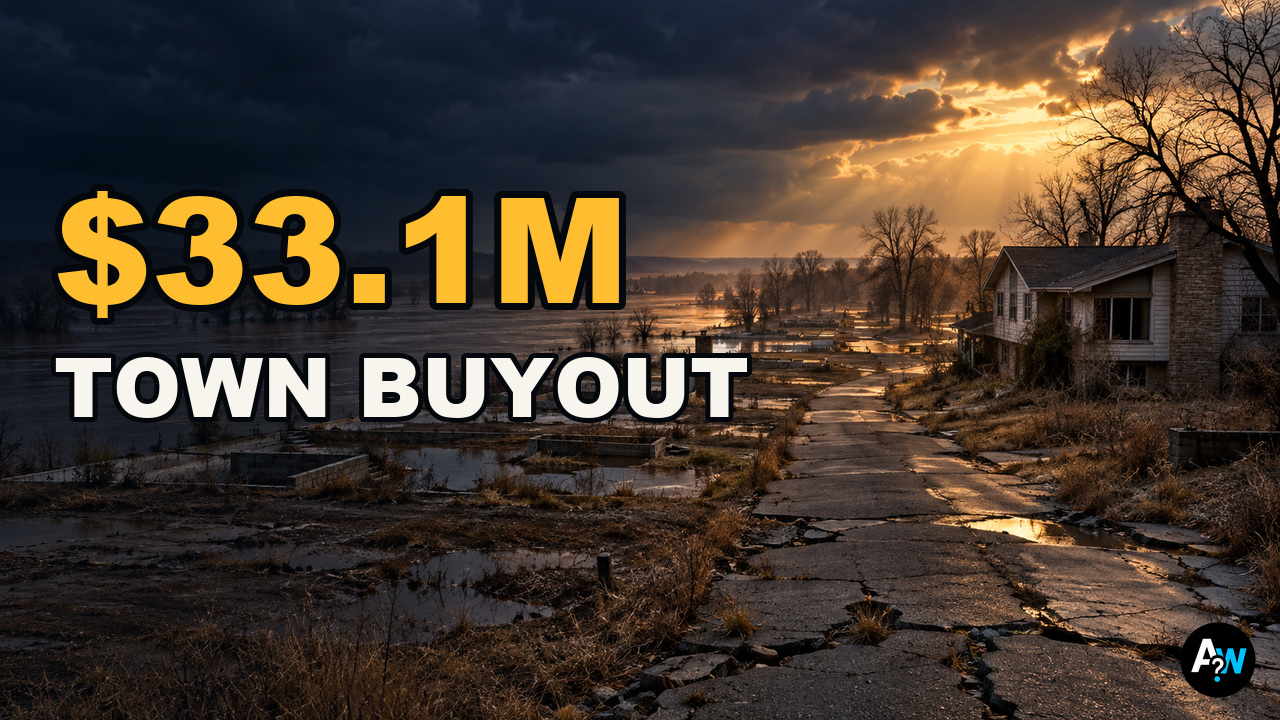
Premieres September 21, 2026 at 8:00 PM CDT. The video will play here after its scheduled YouTube release.
Read the evidence, decisions, and consequences behind this investigation.
The question: The Town That Cost Less to Erase
Why Did the Government Buy and Demolish the Entire Town of Times Beach?
The short answer starts with the roads. By the winter of nineteen eighty-two, the unpaved roads in this small Missouri community were part of a hazardous-waste site.
Years earlier, Times Beach had hired waste-oil hauler Russell Martin Bliss to control dust. The oil he sprayed had been mixed with industrial waste contaminated by dioxin.
Then a record flood drove more than two thousand residents from their homes just as federal testing was exposing the contamination.
Within months, federal and state authorities committed to permanent relocation, backed by a thirty-three point one million dollar transfer from the Superfund program.
But buying the properties only removed the people. It did not remove the contamination. Times Beach would dissolve. Almost every remaining structure would be demolished and disposed of, contaminated material would be thermally treated, and the land would eventually become a state park.
The government did not erase Times Beach because one frightening test proved that the town would be uninhabitable forever. It relocated residents because federal health officials said the contamination posed a continuing threat in a flood-hazard area. Years later, the cleanup decision made a second judgment: restoring permanent housing in this floodplain was impractical and not cost-effective.
A Town Sold With a Subscription
Times Beach began in nineteen twenty-six as a summer-resort development beside the Meramec River. Missouri State Parks says buyers could get a lot with a six-month subscription to the St. Louis Times and an additional sixty-seven dollars and fifty cents.
The seasonal retreat eventually became a year-round Route Sixty-Six community. It was modest, flood-prone, and threaded with unpaved roads. In dry weather, those roads threw dust across homes, cars, and storefronts.
Spraying used oil on dirt roads was an established dust-control practice, and Times Beach contracted with Bliss for the job. To the town, this looked like maintenance, not hazardous-waste disposal.
The danger came from something residents could not see: dioxin, a highly toxic contaminant created as a byproduct in certain chemical manufacturing processes.
And the first major warning did not come from Times Beach at all.
The Horses That Exposed the Chain
In nineteen seventy-one, at Shenandoah Stables, another Missouri property where Bliss had sprayed oil, animals and the owner's six-year-old daughter became ill. The Environmental Protection Agency's later history says more than forty horses died. The deaths helped start an investigation into where the sprayed material had come from.
That trail led toward a chemical facility in Verona, Missouri. Hoffman-Taff had produced a component of Agent Orange there, and Northeastern Pharmaceutical and Chemical Company later produced hexachlorophene. Both operations generated dioxin as an unwanted byproduct.
Independent Petrochemical Corporation arranged for Bliss to remove chemical waste from the chain. The Justice Department's account says Bliss mixed that waste with used oil and sprayed it under dust-control contracts.
A federal court later found Bliss and several corporate entities civilly liable for releases and disposal at six other Missouri sites. But that civil finding did not establish that Bliss knowingly selected a town to poison. Contemporaneous reporting records Bliss saying he had not been told the material contained dioxin. The reviewed evidence establishes what he transported and sprayed, but it does not resolve what he knew.
By the time officials traced the wider disposal pattern, the oil had been on Times Beach's roads for years.
The River Arrives at the Worst Moment
Times Beach learned of possible contamination in November nineteen eighty-two, as the Environmental Protection Agency prepared to test suspected Missouri sites. Crews sampled the town, but before residents could get a clear answer, the Meramec River rose.
The record December flood forced the community out of its homes. Now officials faced two problems at once: soil on the roads might be contaminated, and floodwater might move that soil beyond the places where it had been sprayed. That was a serious concern at the time, although the later cleanup record did not establish that flooding had actually carried dioxin off-site.
The Environmental Protection Agency and the Centers for Disease Control advised residents not to return while testing continued.
The results made the uncertainty harder to dismiss. The Environmental Protection Agency's February nineteen eighty-three release described about two hundred fifty-five samples. Results along streets, shoulders, and ditches ranged from non-detectable to one hundred parts per billion. A few yards and one home had lower detections, above one and below five parts per billion.
Those numbers reflected the standards and assumptions officials were using at the time. Later risk assessments changed, and the figures cannot be casually translated into proof that a particular resident became ill.
But officials had a direct public-health decision to make. Thousands of people were already displaced, the contamination followed the town's roads, and the river could flood the community again.
The Government Buys the Community
On February twenty-second, nineteen eighty-three, Environmental Protection Agency Administrator Anne M. Burford announced a permanent relocation plan for Times Beach. The agency described roughly eight hundred residential properties, thirty businesses, and more than two thousand residents.
The agency transferred thirty-three point one million dollars in Superfund money to the Federal Emergency Management Agency, while Missouri was to supply the required ten-percent share. Superfund was the federal program created in nineteen eighty to address hazardous-waste sites, and here its money was being used to finance relocation.
Residents did not receive that decision as a neat line in a government report. The agency's later history says hundreds gathered outside a locked hotel conference room and heard the announcement over loudspeakers. The scene captured the strange bargain in front of them: after floodwater, warnings, and uncertainty, government could offer a path away from the danger, but only by purchasing the place they wanted made safe.
The announcement offered a way out, but it also made clear that the town people knew was not coming back. Marilyn Leistner, who became Times Beach's final mayor and later its trustee, recalled that most residents wanted the buyout while a smaller group fought to remain.
For families, relocation meant more than exchanging one property for another. It broke apart neighbors, routines, and a municipal identity that no payment could reproduce.
And the relocation announcement explicitly did not solve the contaminated-site problem.
Times Beach formally disincorporated on April second, nineteen eighty-five. The people could leave. The roads, buildings, and contaminated ground could not.
Why Not Clean It and Move Back?
This is where the government's later land-use choice becomes clearer.
In nineteen eighty-eight, the Environmental Protection Agency's Record of Decision examined the site's future. The agency concluded that the entire site lay within the twenty-five-year floodplain. Future residential development was not practical, and restoring housing would require both a more stringent cleanup and expensive flood protection.
Even after removing contaminated material, government would still be rebuilding homes inside a place the river repeatedly threatened. The agency therefore judged residential restoration not cost-effective and planned for controlled, non-residential use instead.
That was the named conflict at the heart of Times Beach's future: restore a town for people to live in again, or accept that the safer practical remedy was to end the town itself.
Cleaning for controlled non-residential use and cleaning for families to live there every day were not the same promise. Residential use demanded a stricter remedy because children and adults would spend their lives on the site, not a few hours visiting it.
And flood protection was not an optional extra for restored housing. Without it, government would be rebuilding a community in a place that flooded frequently.
The question was therefore not whether Times Beach could be made cleaner. It was whether government should spend more to restore permanent housing in a floodplain after the population had already been relocated.
The government kept the relocation permanent. The cleanup could then be designed around land that no longer had to function as a neighborhood.
Demolition, Treatment, and the Town Mound
The Environmental Protection Agency selected the final remedy in nineteen eighty-eight, and a nineteen ninety consent decree assigned major cleanup obligations to Syntex entities.
Those obligations included demolition and disposal of structures, construction and later removal of a temporary incinerator, treatment of dioxin-contaminated material, restoration work, and reimbursement of ten million dollars in federal costs.
The operational distinction matters. Primary records describe structures being demolished and disposed of while contaminated soil and other material went through thermal treatment. So Times Beach was not simply picked up house by house and fed whole into a furnace.
The Environmental Protection Agency later reported that the temporary system treated two hundred sixty-five thousand three hundred fifty-four tons of material from twenty-seven eastern Missouri sites. Of that total, thirty-seven thousand two hundred thirty-four tons came from Times Beach itself.
The scale explains why the buyout could not be confused with the cleanup. Moving the residents took months, but resolving the contaminated landscape took years.
The cleanup was declared complete in nineteen ninety-seven, and the Justice Department estimated its total cost at two hundred million dollars, with responsible-party settlements funding and carrying out much of the work.
The answer: A Park Where the Town Used to Be
Route Sixty-Six State Park opened on the former townsite in nineteen ninety-nine. The Environmental Protection Agency removed Times Beach from the National Priorities List in two thousand one. And a two thousand twelve reassessment found no significant health risk for workers or visitors under the park's current use.
That does not make the loss imaginary. The park is a successful remediation built on top of a community that could not be restored.
So, why did the government buy and demolish the entire town of Times Beach?
Federal and state authorities funded relocation because health officials said the dioxin contamination posed a continuing threat to residents in a flood-hazard area. Then the later cleanup decision kept that relocation permanent because restoring housing in the floodplain was impractical and not cost-effective.
Government money bought the community to end residents' exposure. The cleanup then demolished almost every remaining structure and thermally treated contaminated material so the land could return to controlled public use instead of housing.
Times Beach was not erased by one chemical alone. It was erased because contamination on the roads, a displaced population, and recurring flood risk made saving the place as a residential town the wrong goal.
Stay sharp, Stay curious. And always ask why, guys.
Follow the record.
What did this story make you question?
Comments are reviewed before they appear publicly. Your email is optional and never published.