
Why Does Waffle House Run Its Own Hurricane Command Center?
The breakfast chain turned an always-open promise into a disaster logistics system watched by emergency managers after major storms.
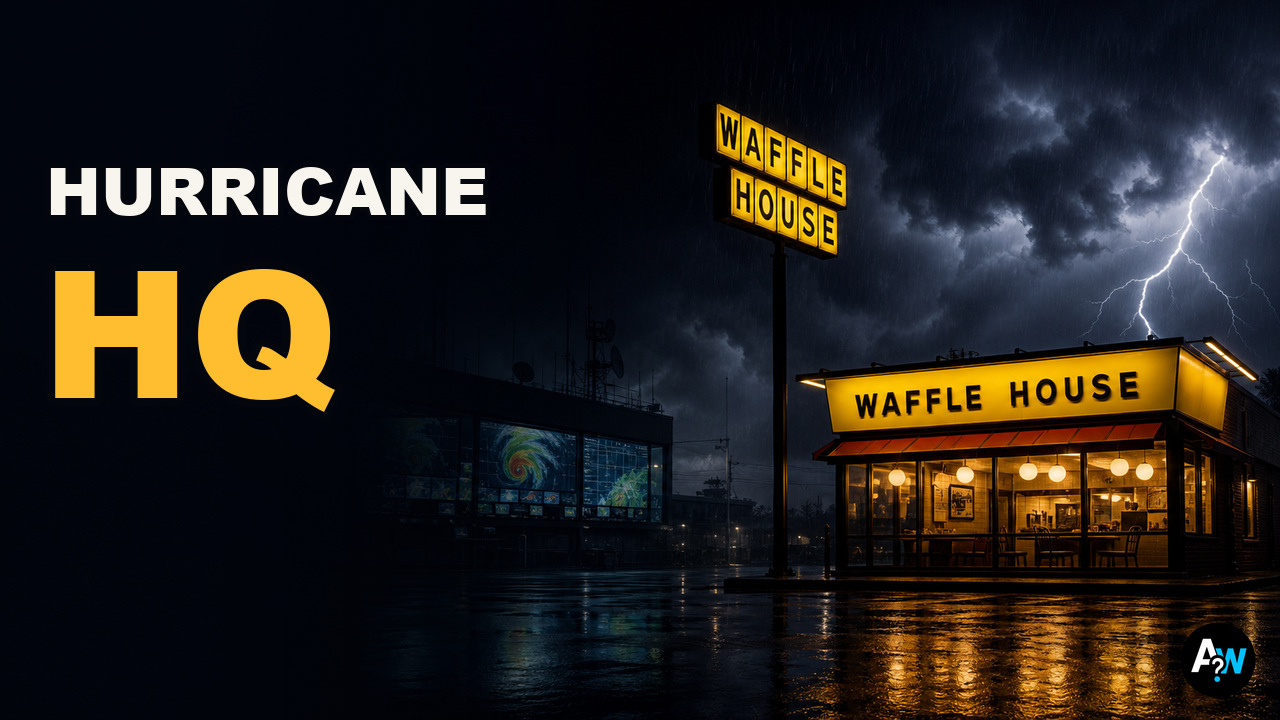
Premieres July 27, 2026 at 8:00 PM CDT. The video will play here after its scheduled YouTube release.
Read the evidence, decisions, and consequences behind this investigation.
The question
Audio: 02voiceover/vo01coldopenv2.wav · 0:00.0–1:10.5 (70.5s)
Why does Waffle House run its own hurricane command center? The morning after a hurricane makes landfall, a stretch of coastline can look like the power grid simply gave up. Traffic lights dead. Gas stations shuttered. Grocery stores dark, their freezers already spoiling. And then, somewhere in the middle of all that, one low yellow sign is still lit, and inside, someone is cooking scrambled eggs and sausage biscuits on a gas grill, by the light of a generator. It's a Waffle House. And the fact that it's open is not luck, and it's not stubbornness. It's the output of a genuine crisis-management operation, a command center, a special storm menu, a fleet of generators, and a playbook, run by a chain of cheap, twenty-four-hour diners. This is the story of why a company that sells five-dollar waffles built something that works like an emergency-management agency. And why the U.S. government started paying attention.
The Promise
Audio: 02voiceover/vo03act1promise.wav · 1:32.6–3:11.2 (98.6s)
Waffle House opened its first location on Labor Day, nineteen fifty-five, in Avondale Estates, Georgia, the idea of two neighbors, a restaurant man named Joe Rogers Senior and a real estate agent named Tom Forkner. From the very beginning, the pitch was simple and a little radical for its time: good, hot food, fast, at any hour. Not open late. Open. Always. Twenty-four hours a day, seven days a week, every day of the year. Seventy years later, that single diner has grown into roughly two thousand restaurants across about twenty-five states, still privately held, still run out of Georgia. And that original promise, always open, didn't just survive. It became the entire brand. Waffle House is not really selling waffles. It's selling reliability. The idea that the door is always unlocked, the grill is always on, and no matter what your night looks like, there is a booth waiting. The brand lore even says many locations were built without a good way to lock the front door in the first place, because why would you ever need to? Which sets up the one problem that threatens the whole thing. Because there is exactly one force that reliably closes everything: a natural disaster. A hurricane doesn't care about your brand promise. It closes the grocery store, the pharmacy, the gas station, and every other restaurant on the road. So the one company whose entire identity is we never close runs headfirst, every single storm season, into the one thing designed to close it. Most companies would accept that. Waffle House engineered its way around it.
The Machine (Storm Center)
Audio: 02voiceover/vo04act2stormcenter.wav · 3:11.2–4:14.2 (63.1s)
Go to Waffle House headquarters in Norcross, Georgia, when a major storm is spinning up in the Gulf, and you'll find a room that has been converted into something that looks a lot like a disaster-response center. Screens tracking the storm's path. People tracking which restaurants are in the cone, which ones still have power, which ones are about to lose it, and where the supply trucks are. It's called the storm center, and when it activates, the company essentially goes on a war footing. The centerpiece of the plan is deceptively simple: a special, stripped-down storm menu. Under normal conditions a Waffle House will make you almost anything. But when a location is running on backup power, the menu shrinks to a short list of things that can be cooked on a gas grill with limited refrigeration. That's not a compromise, it's the strategy. By deliberately narrowing what each restaurant offers, the company lets its supply chain focus on keeping a handful of key ingredients stocked and cold, instead of trying to keep a full menu alive in a disaster zone.
The Machine (Infrastructure)
Audio: 02voiceover/vo05act2infrastructure.wav · 4:14.2–5:36.8 (82.6s)
And the menu is only the visible piece. Behind it is the actual infrastructure of not-closing: portable generators staged to move into the hardest-hit areas. Restaurants designed to cook on gas when the electricity is gone. Mobile command units. Jump teams, crews pulled in from unaffected regions and sent toward the storm to relieve exhausted local staff and get dark restaurants back open fast. None of this happened overnight. Waffle House started building this muscle decades ago, after Hurricane Hugo tore through the Southeast in nineteen eighty-nine. But the thing that turned a set of instincts into a real system was Hurricane Katrina. In two thousand five, Katrina destroyed seven Waffle Houses and shut down about a hundred more, and in the aftermath, the company hardened everything it had learned into a written playbook for exactly how to reopen a restaurant after a catastrophe. Put it together and you have something genuinely strange: a low-margin breakfast chain running logistics that would not look out of place at an actual relief agency. Which raises the obvious question, who on earth would notice that a diner is doing this? The answer is: exactly the people whose job is to notice.
FEMA Notices (The Index)
Audio: 02voiceover/vo06act3femaindex.wav · 5:36.8–7:36.1 (119.3s)
In August of two thousand four, a hurricane named Charley tore across Florida, and a man named Craig Fugate was running the state's emergency management division. Fugate needed fast, ground-level reads on how badly each area had actually been hit, faster than official damage assessments could deliver. And he noticed a pattern. The Waffle Houses were often the first businesses back open after a storm. So he turned it into a rule of thumb. If you rolled into a town and the Waffle House was open, serving a full menu, things probably weren't that bad. If it was open but running that limited storm menu, the area was hurting: power was out, supplies were short. And if the Waffle House itself was closed? Then you knew you were somewhere truly serious, because it takes a lot to close a Waffle House. Green, yellow, red. Fugate later put it bluntly: if you get there and the Waffle House is closed? That's really bad. He called it the Waffle House Index. When Fugate went on to lead FEMA at the national level, the phrase went national with him, and by twenty eleven it was showing up in the Wall Street Journal and everywhere after. Now, here's where a lot of tellings get sloppy, so let's be precise. The Waffle House Index is not some official government instrument with a budget and a control room. It started as one emergency manager's shorthand, and it has stayed essentially informal, a records request years later indicated it was really Fugate's own tool, not a formal FEMA program. But that almost makes it a better compliment. Emergency managers didn't adopt Waffle House because of a contract. They adopted it because the company had made itself so reliable that its open sign became a genuine signal about the state of the world.
What It's Actually Buying (The Money)
Audio: 02voiceover/vo07act4themoney.wav · 7:36.1–9:03.9 (87.7s)
Which brings us to the real question. Why does Waffle House go to all this trouble? A command center, generators, jump teams, a playbook, to keep a five-dollar breakfast flowing into a disaster zone. That is not cheap. So what is Waffle House actually buying? The easy answer is money, and there's a real version of that answer. When a storm passes and a Waffle House is one of the only places open, business explodes. People have lost power, their food has spoiled, every other restaurant is closed, and suddenly the diner that's still serving is the only game in town. Managers have said sales can double or even triple in the aftermath of a storm. After Katrina, the locations that reopened fast saw exactly that kind of surge. So you'd think the whole thing is a clever way to capture a spike in demand. Except the company itself says that's not it. By Waffle House's own account, if you add up everything a storm deployment actually costs, the generators they lease, the supplies they truck in, the extra crews they bring in from out of state, the places they have to put those crews up, the operation costs more than the sales it brings in. As the company's spokesman Pat Warner put it: you can see we aren't doing it for the sales those restaurants generate.
The answer
Audio: 02voiceover/vo08act4thepayoff.wav · 9:03.9–10:21.4 (77.5s)
So if it's not the sales, what is it? It's the single most valuable thing a brand can own, bought at a discount: proof. Waffle House spends almost nothing on advertising. It doesn't have to. Because every time it keeps a restaurant open through a hurricane, it delivers, in the most dramatic way imaginable, on the exact promise the whole brand is built on, the door is always open. You cannot buy that kind of trust with a commercial. You earn it by being the warm meal and the working bathroom and the one light on in a neighborhood that just lost everything. The storm operation isn't a marketing budget line. It is the marketing, the most credible ad the company will ever run, and it airs precisely when people are paying the most attention. That's the inversion at the heart of this. Staying open in a disaster looks like charity, or looks like recklessness. It's neither. It's the coldest, smartest brand-building there is, disguised as a plate of eggs.
The answer
Audio: 02voiceover/vo09closeroutro.wav · 10:21.4–11:26.4 (65.1s)
So, why does Waffle House run its own hurricane command center? Because everything in it, the storm menu, the generators, the jump teams, the playbook, the room full of screens in Norcross, exists to protect one thing: the promise that the door is never locked. That promise is the whole company. And a hurricane is the only thing that can truly test it. So they built a machine to make sure that when the test comes, the answer is still yes. And the proof that it worked isn't a sales number. It's that somewhere along the way, the people whose actual job is measuring disasters started using that open sign as a measure of the disaster itself. When the government's rough gauge of how bad things are is whether you managed to stay open, you didn't just keep a brand promise. You became the baseline for normal. If you want another company that turned a single stubborn promise into its entire identity, go watch our episode on why Costco refuses to raise the price of its hot dog. Same idea, different weapon. Stay sharp, Stay curious. And always ask why, guys.
Note for Codex: Section boundaries above are exact (from the .wav durations). Visual beats need a frame-accurate pass against these waveforms during editing. Per owner direction, visuals use licensed real-brand Waffle House stock — see 00brief/CODEXHANDOFF.md.
Follow the record.
What did this story make you question?
Comments are reviewed before they appear publicly. Your email is optional and never published.